Yes, it is april 2022 and we have a puppy! In this article I share more about it :).
I love dogs. That has not always been the case. As a child I liked them until I was bitten by a small dog. I became afraid of dogs.
Fear of dogs
When I studied Applied Psychology I got to know Schapendoes Aagje. A Schapendoes is a dutch breed, loosely translated as; dutch Sheepdog. Aagje got me over my fear of dogs. She regularly stayed with me and I became a Schapendoes fan!
Then it was time for a ‘own’ dog; I am grateful that Schapendoes Otje has been in my life for eleven years.
After that we wanted a Schapendoes (a girl) again; timing wise, we decided to listen to our gut.
A puppy from Sweden 🙂
Mathijs and I have been traveling the world indefinitely since 2017. We are currently in Sweden. Here came a litter with 3 Schapendoezen on our path, including 1 girl. Below I share some pictures and more about her character and her name:
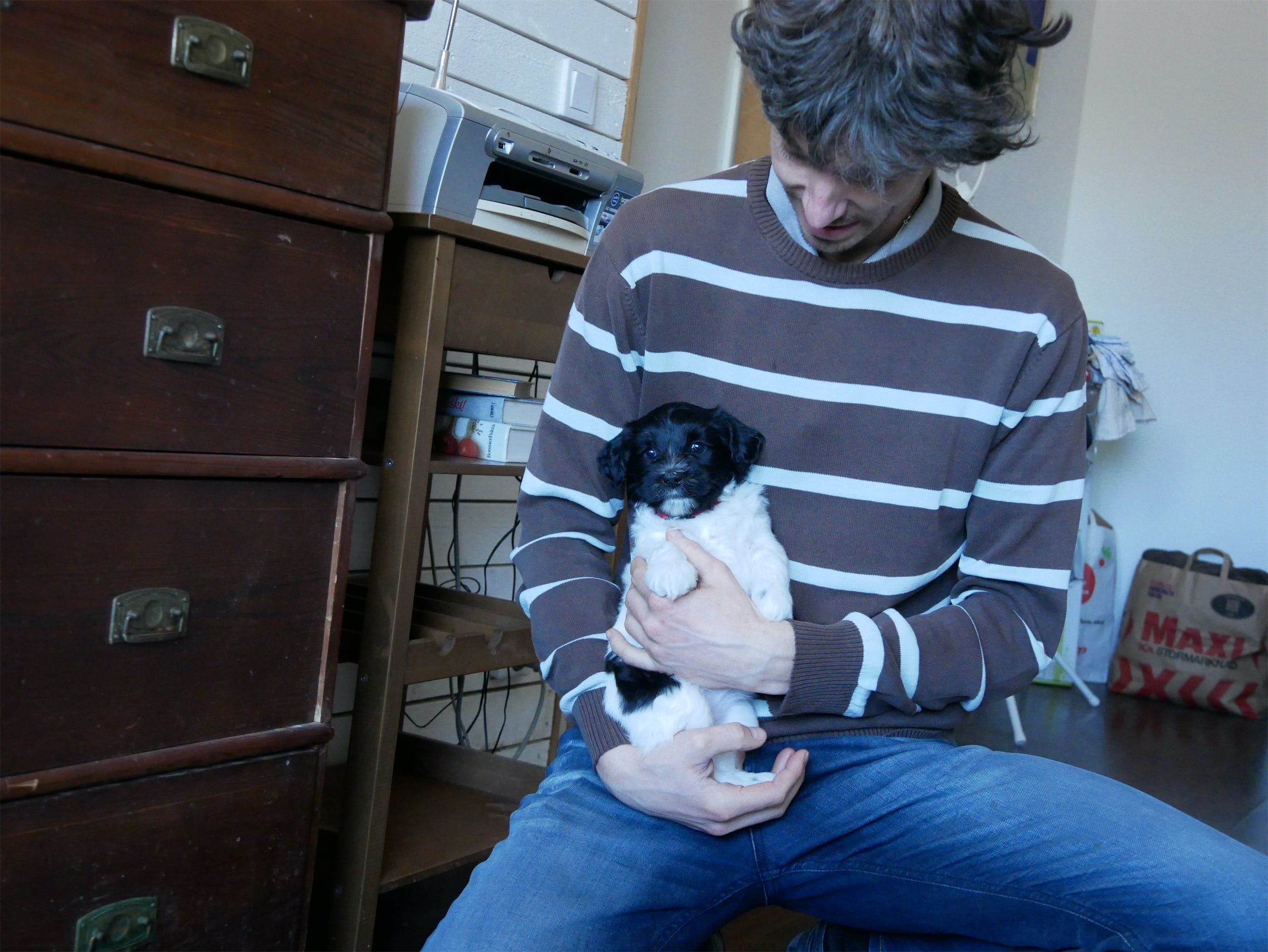
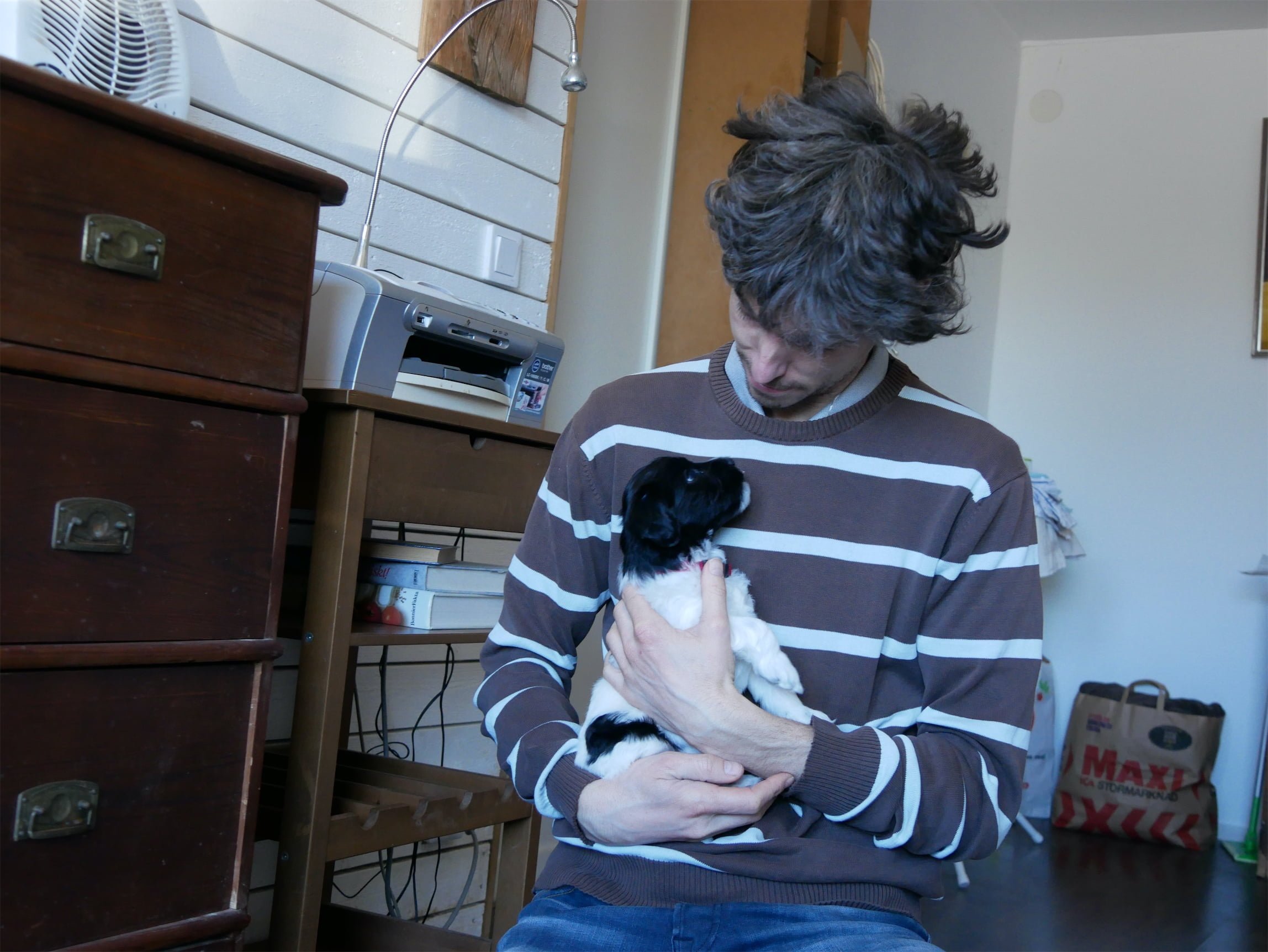
Schapendoes puppy 4 weeks
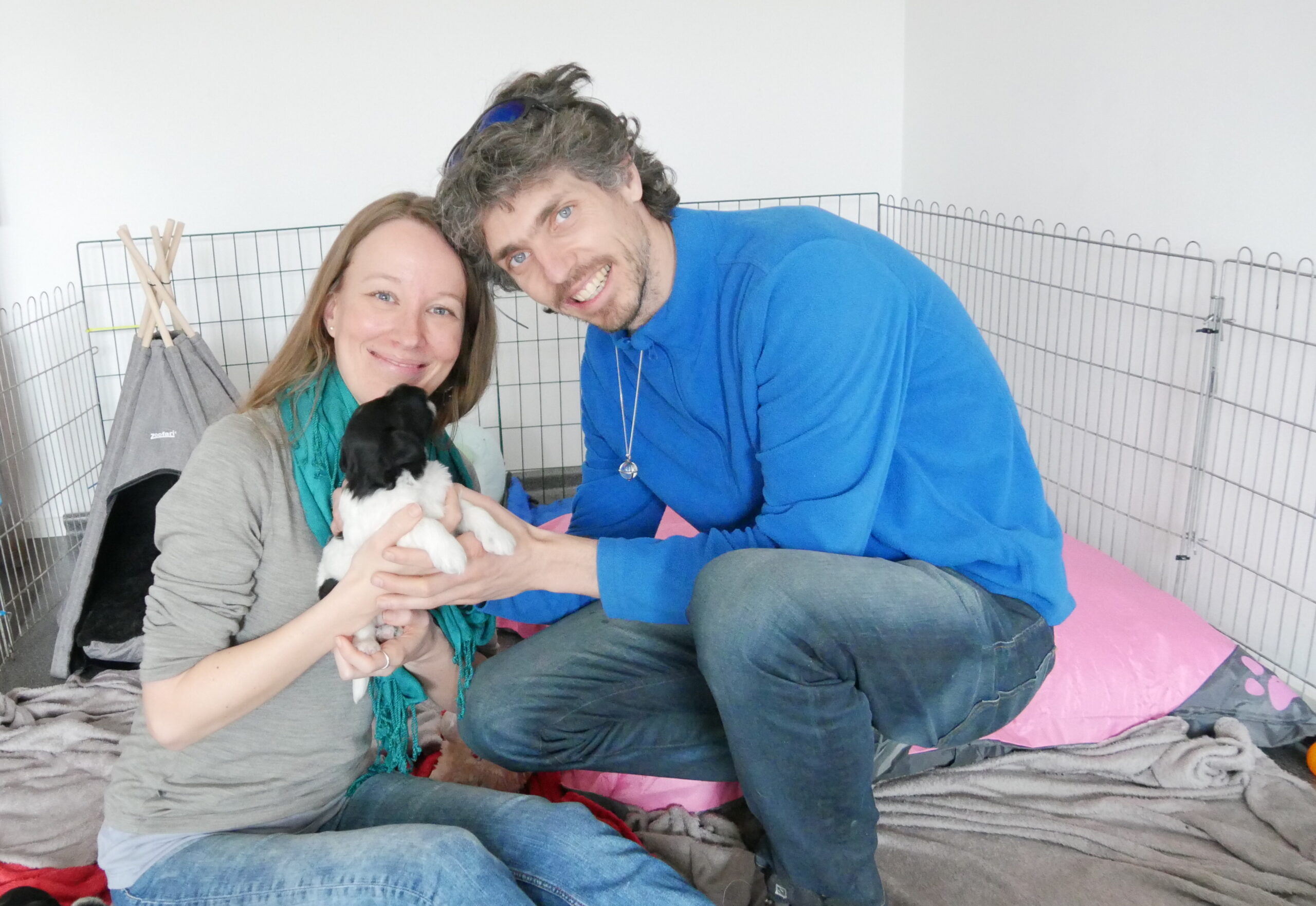
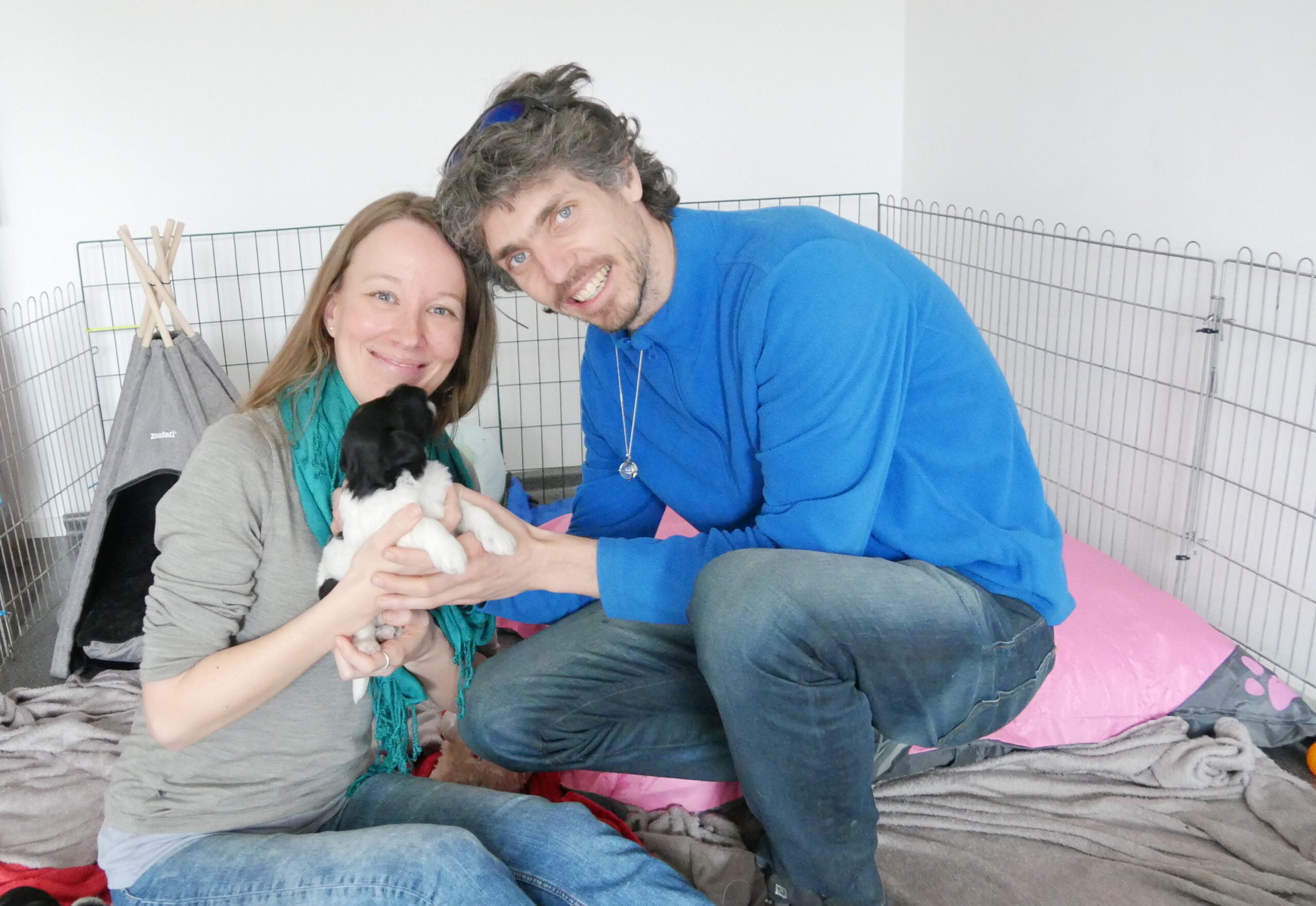
We met the puppy when she was 4 weeks old (many breeders in Scandinavia do this).
This is our first photo together!
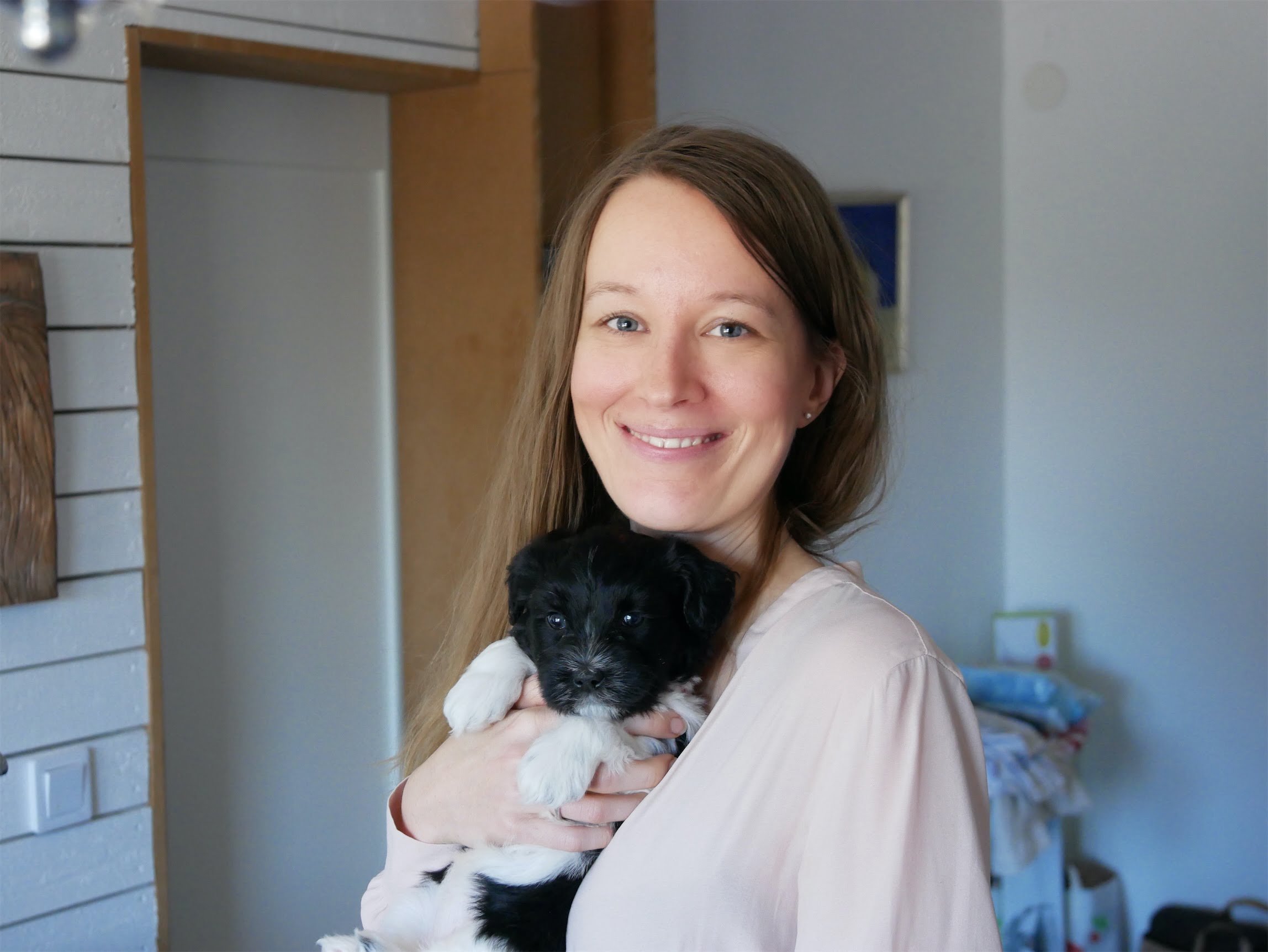
She is now black and white with sporadic gray hairs (there is a chance it will stay that way).
Her eyes are still blue, over time this color changes (they are expected to turn brown).
Schapendoes puppy 5 weeks
Schapendoes puppy 6,5 weeks
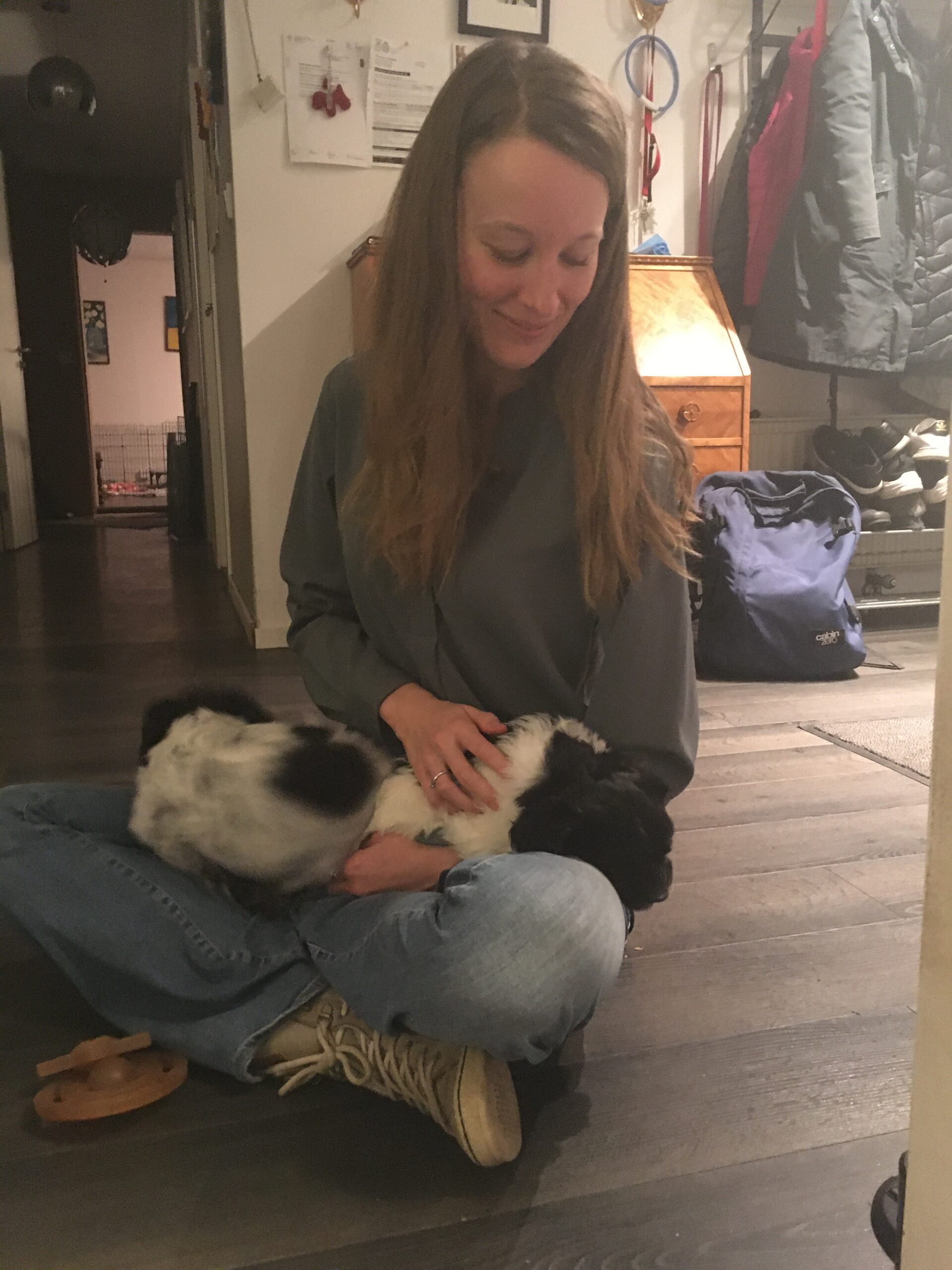
We arrive in the evening. The girl (on the right in the photo) falls asleep on my lap. It’s my lucky night :). I hold her in my hands (the black/grey puppy on the left that moves is her brother).
The next day the puppies are introduced to our motorhome. The puppy lying against the fridge is the girl.
Character Schapendoes puppy
When we visit her, the puppy is usually the first to wake up and the last to go to sleep. She is more active, curious and inquisitive compared to her brothers. Ze loves to discover the world just like we do. If she was human, she was probably a (digital) nomad ;).
We are grateful that the breeders entrusted us with this girl and she is our new puppy. A perfect match! We are very happy with this. We picked her up on Saturday, April the 2nd, 2022.
Announcement of here name!
How we came up with the name
Before the puppy was born I had made a list with possible names. In the course of time and after the meeting with the puppy, this has expanded considerably.
The puppy was born in Sweden in Skäne. When we got to know her we were staying in Småland. We regularly spend the night with the camper on the coast near the puppy, so that we could admire her for several days.
The name came to me through a lucid dream
During one of those nights, I had a lucid dream (a dream in which I became aware that I was dreaming while my body was asleep). I decided to investigate what name we could give her. I got through five names. Many of those names were on my very first list and we had already discussed. One name had my preference right away in my dream.
When I woke up I shared the dream and the name options with Mathijs.
We are happy to share the name:
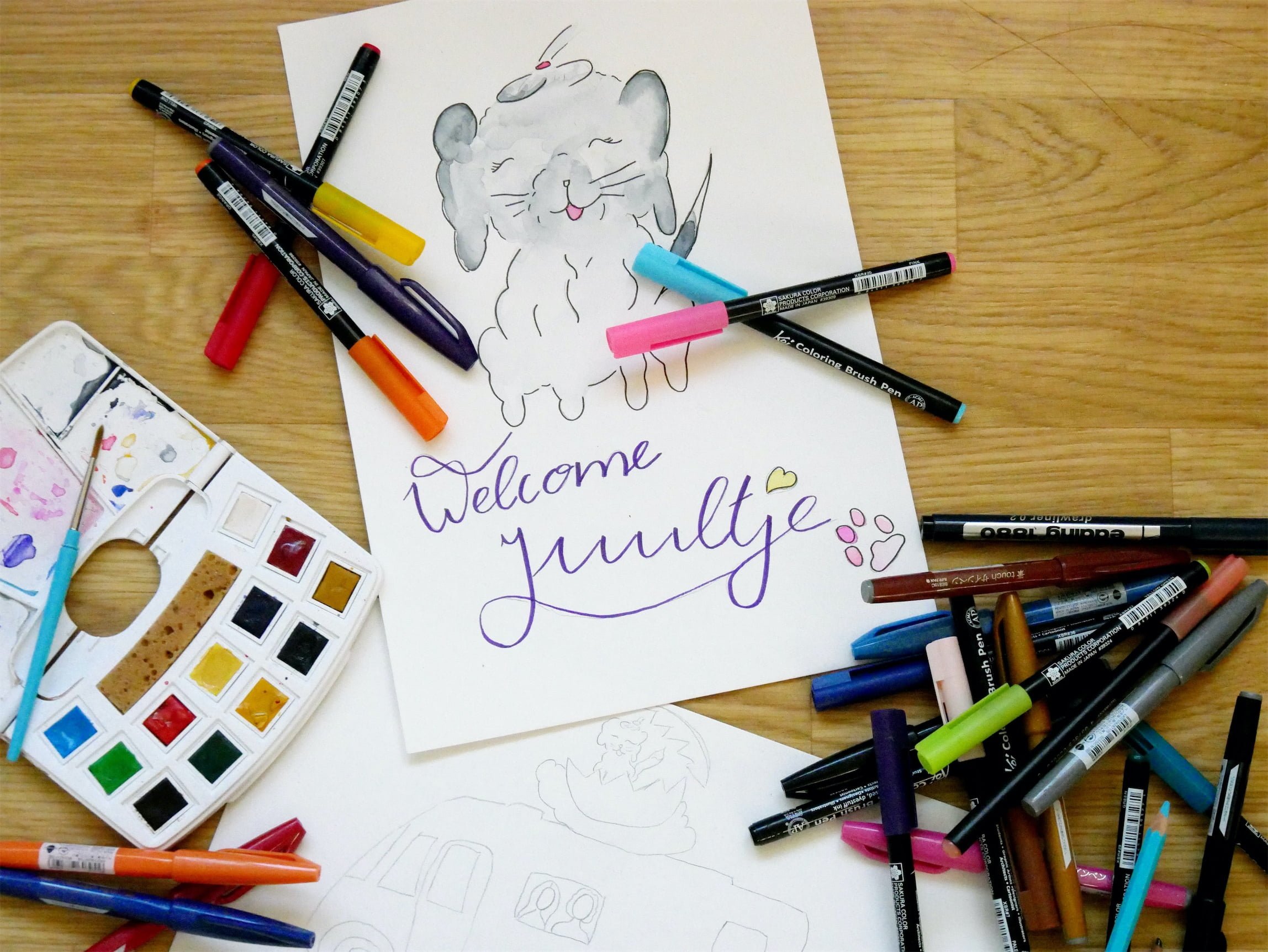
It has become Juultje!
How did the first week go?
We picked up Juultje with our motorhome and she made her first trip with us! The travel went fine. We took regular breaks. At some point she fell asleep.
When she first entered our temporary home, she acted as if she had lived here for years.
She likes to be around us.
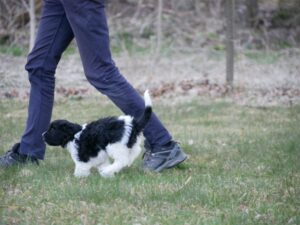
Juultje likes to discover new things, such as our temporary garden. Here she regularly hops around happily.
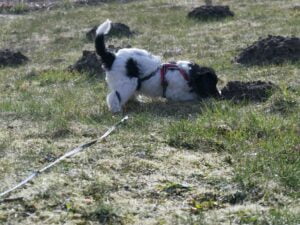
For example, she sniffs and plays with leaves and twigs and digs open molehills a bit. Her white paws remain surprisingly white.
She is also introduced to various weather conditions such as rain and snow.
Juultje is almost newspaper-trained.
We teach her to pee outside. Sometimes this goes well :).
We do our best to socialize her optimally and, for example, to introduce her to stimuli (such as other dogs and people) that she will also have to deal with in the future. She also sleeps a lot, so everything can be processed well ;).
We think Juultje is a fantastic puppy and we are grateful that she came into our lives :).
[nv-custom-layout id=”1639″]
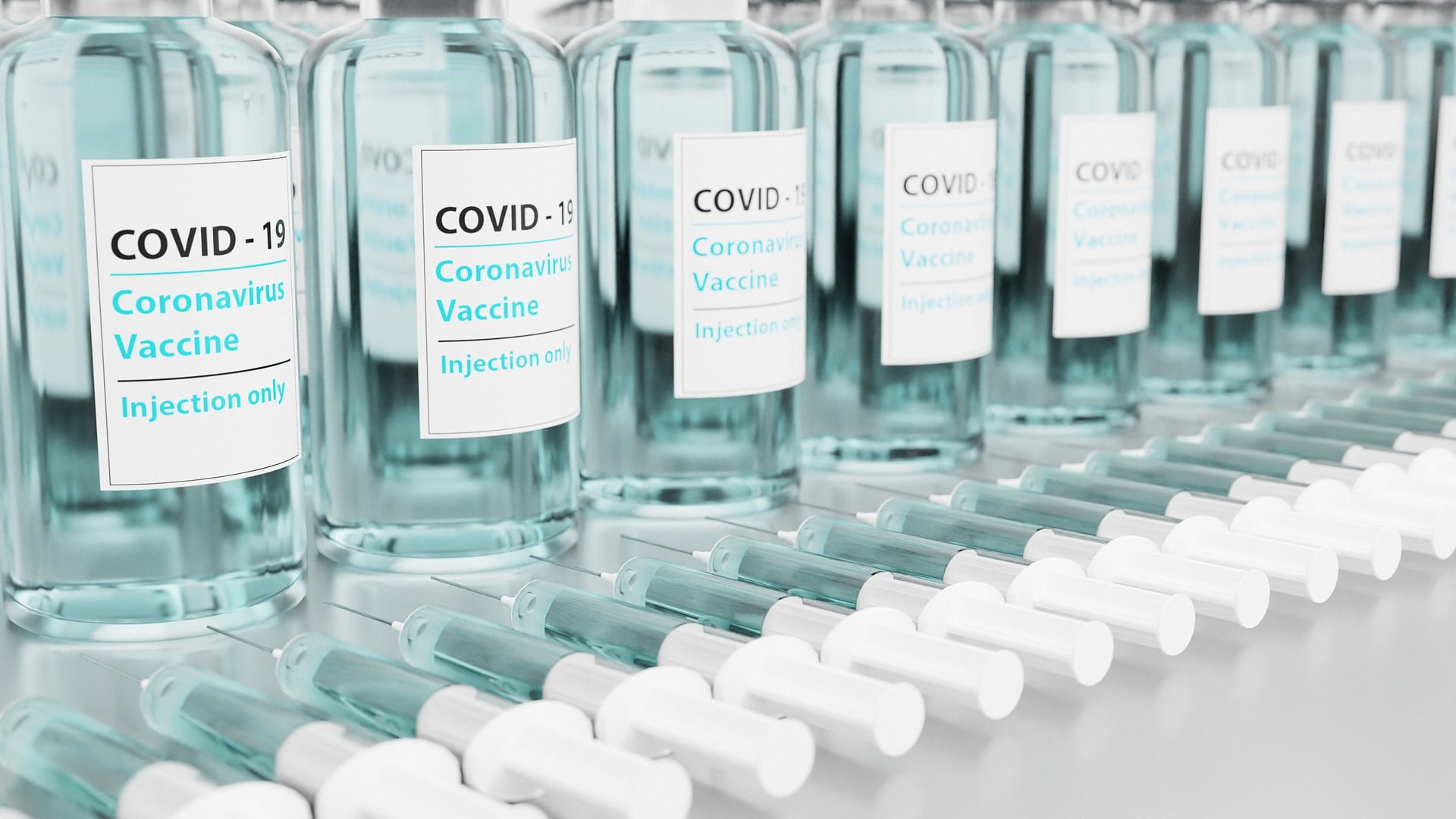
If you are thinking about vaccination against COVID, it is good to make an informed choice. In this blog I will inform you about the choices and you will discover how you can support yourself energetically.
Choice 1 – healthy living
There are several studies that show that structural vitamin D use has a very positive influence on the course of COVID. The number of deaths would be drastically less. There are more options for strengthening your immune system, such as sufficient exercise, vitamin C, zinc, L-Lysine and other good nutrition. The chance of dying from COVID if you live healthy is very small. Exceptions to this are genetic factors that limit your immune response to this virus and underlying disease.
Option 2 – vaccination
In addition to a healthy life and strengthening your immune system, you can also opt for vaccination, because you feel that this is right for you, but perhaps also because you are asked for your work or because you experience social pressure.
Side effects
There are known side effects from the vaccine. This will be registered. At the moment, only the short-term effects are known. The long-term effects of 2, 5 and 10 years could not yet be investigated, because these vaccines have not been around long enough for that.
Known side effects of the COVID vaccine are headache, dizziness, fever and a red spot at the puncture site. This is not only due to the antibodies that you will be producing, but also because your body removes additives from the system that are in the vaccine. In the UK they keep track of the side effects of the different vaccines. The UK government documents can be found here.
If you are planning to have a COVID vaccination then I recommend supporting your body both before and after the vaccine. In this way you can reduce or prevent any complaints in the short and long term.
In the text below I share a number of options that can support you. Feel for yourself what can help you.
1) Primordial Light Healing
With a Primordial Light Healing (Oerlicht Healing in Dutch) you can support your body to get rid of foreign substances. A Primordial Light Healing takes 10 minutes, because it is very strong. A Primordial Light Healing can be done from a distance.
I recommend a Primordial Light Healing the day before the vaccination in preparation, in the hours after the vaccination and two weeks after. I recommend repeating this for two injections.
As founder of Primordial Light Healing I also do group Primordial Light Healing where this can be received. For more information about Primordial Light Healing you can send me a message.
Meditation energy card
Ascended Masters and Angels are happy to support us. I have created a symbol that supports the energetic neutralization of the vaccine and have decided to make it available for free. You can look at the symbol and then do a 10 minute meditation with this energy.
Step 1: Look at the symbol. Step 2: If you feel you are connected or after 30 seconds close your eyes. Step 3: Ask de Angels and Ascended Masters from your heart to support you. Step 4: Let the energy flow for 10 minutes.
Repeat this for 3 times. 1) Before vaccination 2) Shortly after vaccination 3) 1 week after vaccination
If you have a second vaccination. Repeat the steps again.
If you have problems caused by the vaccine you can meditate one week for 10 minutes a day.
Other tips:
Drink enough water, preferably energized.
Do not make intensive efforts, but moderate effort so that your body gets rid of waste products through sweating, among other things.
Everything is energy. Disturbances or blockages of energy can cause accumulations or shortages of energy in various places, which can manifest as physical, emotional and/or mental complaints (this can sometimes be diagnosed as a disease).
Healing can take place in various ways. Surgeons often heal the body by literally cutting into it (via surgery). There are also other forms of healing. For example, regular psychologists often work on healing on a mental level. Usually, healing refers to a healing that balances your soul (spiritual core), thoughts, emotions and body. Here you will find more forms of healing.
Effects of healing
The effects on the physical, emotional and mental level of the client can be noticed immediately or in the long term (for instance after several sessions). Symptoms may decrease and possibly disappear.
However, it is a great misunderstanding that healing always means a literal cure, that the cause of the illness is removed and the complaint 100% disappears. Although this is possible, it is not the goal of healing: the goal of healing is to bring someone back into contact with himself/herself and to let his/her soul energy flow optimally again. So that someone is comfortable again, and can deal with what is present.
Therefore, always consult a doctor in case of complaints: healing is a form of alternative health care and an addition to regular care (it is not a replacement).
Giving or receiving healing?
You can either give or receive healing.
Giva a healing
If you want to give a healing, it is advisable to follow a good training in this. In this way you can prevent yourself from getting exhausted during or after giving a healing and the person you are giving the healing to will feel worse instead of better. Someone who is professionally trained to give healing is called a healer.
What is a healing session?
A healing session is a contact moment in which healing takes place; a healer gives healing to the receiver. This can take place in real life, but also at a distance.
Usually a healing session takes place individually (1 on 1), but it can also take place in a group. Usually this is called group healing.
Are you looking for a healer or healing training? Tips:
Choose a healer/healing education:
Who feels comfortable. Each way of healing resonates with a different energy/frequency; choose something that makes you happy. The energy of healing also works ‘at a distance’, therefore a healing (training) can be given in real life and online.
Who works ethically and respects your boundaries and free will and choice. For example, it is not okay if someone gives you unsolicited (remote) healing without your physical and literal consent. This is energetic trespassing. HSPs can (unconsciously) suffer from this. In a good healing training you will learn more about this, also what you can do if you want to heal someone who cannot speak (such as a baby, someone in a coma or an animal).
Forms of healing
Healing can take place in all kinds of ways and can consist of various steps. A well-known form of healing is Reconnective Healing. Find out more about it below and go to:
A form of healing is Energy healing (formerly: Esoteric healing). This is given among others by the NNEH (Nederlands Netwerk Energy Healing) and INEH (International Network for Energy Healing).
Energy Healing is based on the ideas of Ascended MasterDjwal Kuhl. Djwal Kuhl is also called ‘Tibetan’. He has lived on earth before, and is thought to have reincarnated earlier than King Caspar (one of the three saints who gave Jesus a gift), philosopher Confucius and philosopher Lao Tse (also called Laozi).
An Energy Healing therapist is trained to perceive energy and imbalance. The healing is focused on discovering the causes of the complaints, rather than fighting the symptoms.
The therapist’s intention is to trigger the self-healing capacity of the client, so that their soul energy can flow to where it is needed. No energy is added to or taken from the energy of the therapist. In contrast to Quantum Touch the client is not touched, but work is done at ‘distance’ (this can also be done literally from different parts of the world).
Energy Healing experiences
Femke: “I followed the course Energy Healing, it taught me how I could work consciously and practically with energy. I found it a real ‘do- and experience’ training. Later I discovered that there are many more ways to heal.
For example, in this training soul consciousness was very central; there are also other forms of consciousness that can be very effective for healing. I also missed learning to work deeply with light beings.”
Healing in lucid dreams
Lucid dreams are dreams in which you are aware that you are dreaming while your body is asleep. You are face to face with your unconscious. Here you can engage in healing on a profound unconscious level.
Some people see high sensitivity as a disease, or as something you have to get rid of; this is a misunderstanding. High sensitivity is a quality, but can be a burden if it is not well managed yet. Maybe you are easily over-stimulated or tired as a HSP. Healing can support you in this, but it is not the solution.
It is a misunderstanding that high sensitivity problems can be solved by someone else such as a healer. Some HSP for instance become dependent on a healer.
If you suffer from high sensitivity problems, you have to start working with yourself.
Animal healing
Healing can be applied to humans, but also to other living beings such as animals.
Ascension Tools
Ascension Tools are glass light instruments/products that resonate with the energy of Atlantis. They can easily be used to give a healing, for example to adults, children and animals. Some HSPs use them to shield themselves better and to stop being bothered by entities or electromagnetic radiation.
Discount code for Ascension Europe
We collaborate with Ascension Europe. This article therefore contains affiliate links. If you order something from Ascension via the links in this article, we will receive a small compensation for this and you support us. We appreciate this very much! You don’t pay anything extra.
Are you going to order something from Ascension Europe for the very first time? Tip: use the discount code: mathijsvanderbeek and get a 3% discount on your product(s) (this code does not work in combination with other codes/promotions and will not be applied to any shipping costs)!
What is a healing environment?
A healing environment is an environment that has the intention to support people both professionally and privately and to prevent complaints such as stress. Physically, emotionally and mentally. Just think of:
people in a hospital. The term is best known for its use in healthcare.
a family in a house.
employees in an office.
A healing environment can consist of elements that can also be found in nature, such as:
photos of nature
plants (preferably real ones (instead of artificial ones)
silence
an electrosmog free environment (internet on a cable, instead of WIFI)
clean air
daylight
special colors (such as green)
It can also consist of:
inspirational magazines in a waiting room
a ‘waiting line’ so that people feel they have privacy
Slowly the Chinese man walks in my direction. I know he wants to kill me and I feel an oppressive fear. In the past I would have fled, or woken myself up by screaming. Now I realize that I am dreaming, while my body sleeps. I choose to surrender to the dream, let the man come to me, observe how fear flows into my dream body, and let the man do what he wants to do. Suddenly the man takes me to a totally different dream scene. The fear is gone. When I wake up I feel strong and realize that my core is immortal. These kinds of dreams have not only changed my dream life, but also my waking life for the better. And they can change your life too!
What are lucid dreams?
Lucid dreams are dreams in which a person is aware that he/she is dreaming while sleeping. The word lucid is derived from Latin (lucidus) and means luminous, clear and bright. The term lucid dreaming was coined in 1913 by the Dutch psychiatrist Frederik van Eeden, who often dreamed lucidly. Lucid dreaming has been scientifically proven, among others by Dr. Hearne and Dr. LaBerge.
Why would you want to have lucid dreams?
Your subconscious determines for approximately 95% your life, including thoughts, feelings, emotions and actions. Lucid dreams offer you the possibility to stand eye to eye with your subconscious and communicate directly with it.
In a lucid dream you can exercise influence on a dream. Lucid dreams help you to let your unconscious work to your advantage during the night and during the day, so that you can have a pleasant (dream) life.
Approximately 33% of your life is spent sleeping, of which approximately 25% is spent in the dream state. When you reach the age of 90 you will have been dreaming for an average of 7,5 years. How do you want to organize this time? There are several reasons for lucid dreaming, these are connected to the advantages of lucid dreaming.
Advantages of lucid dreaming
Lucid dreams have numerous physical, emotional, mental, relational and spiritual benefits, these are some examples:
General benefits of lucid dreaming
Lucid dreams can give you strength and inspiration, help you to wake up pleasant and energetic and give you a grip on your dreams.
With a lucid dream you can discover the meaning of your dreams. The meaning of a dream can be very different from what you have thought up with your conscious mind in your waking life, because you are now communicating directly with your unconscious.
Furthermore, lucid dreams can help you to be more creative, to make your daily life easier and to experience a more pleasant daily life. They can provide insight, for example in how you use a talent (such as high sensitivity) better or what energy guzzlers are and how you get more energy.
In addition, in a lucid dream you can support yourself on a deep, unconscious level with energetic healing on a physical, emotional and mental level. Mr. S. had 22 years of chronic pain, which completely disappeared after a lucid dream. In case of complaints, always consult a doctor.
Physical benefits of lucid dreaming
Lucid dreams have physical advantages. For example, in a lucid dream you can be engaged in activities that you cannot do in waking life. If you have a physical limitation, you can often make use of what limits you in your daily life in a lucid dream. Think of limitations of your eyesight or limbs and such.
Furthermore, in a lucid dream you can learn to improve skills from your waking life, such as playing sports, making music, giving a presentation or practicing an important conversation like a job interview. Research shows that practicing motor skills and sports in a lucid dream can lead to improvements in these skills in waking life.
You can also plant energetic seeds that will help you attract abundance in your waking life.
Emotional benefits of lucid dreaming
In a lucid dream you can do what you like and enjoy it. Lucid dreams can help to create emotional balance. For example, you can resolve worries, transform emotions such as fear and gloom and overcome nightmares. Some scientists suspect that lucid dreaming is a good remedy for (recurring) nightmares. There are studies that confirm this thought (like this study and this study). With lucid dreaming you can increase self-confidence, overcome shyness and find happiness.
Mental benefits of lucid dreaming
Lucid dreams have mental advantages. They can support you to make choices that really suit you and solve problems. A study found that people who dream lucidly are better at solving problems in the waking world. Lucid dreaming can help you profoundly transform your mind and limiting beliefs and create more flexibility and adaptability.Furthermore, you can develop your focus and concentration skills. If you like to meditate, then you can improve your meditation skills.
Relational benefits of lucid dreaming
With lucid dreaming you can improve relationships and resolve any conflicts, even with people who have passed away. You can help others. You can also develop empathy and compassion; for others and yourself.
Spiritual benefits of lucid dreaming
Lucid dreams can help you to develop your consciousness, to experience oneness (instead of loneliness and separation), to come to yourself, to ‘anchor’ in yourself and to live from your core.
Some people experience through lucid dreaming that there is more between heaven and earth, which helps them to transform fear of death.
Furthermore, with lucid dreaming you can thoroughly purify karma (such as undermining thoughts, emotions, actions and habits). Furthermore, lucid dreams offer you the possibility to experience contact with light beings (such as angels and ascended masters) on a subtle level and to receive inspiring teachings from them. In a lucid dream you can also communicate with deceased people and help souls who are stuck or confused in the afterlife.
History of lucid dreaming
Lucid dreaming has been taught and applied in many cultures and religions for centuries, for example by the ancient Egyptian civilization, various ‘primitive’ tribes and Hindu, Taoist and Buddhist religions.
Tibetan Buddhism (such as the Dzogchen tradition) considers dreams very important: they see lucid dreaming as a possibility to develop consciousness, through which one can become enlightened. For Tibetan Buddhists, developing this mastery is the main purpose of dreaming.
After lucid dreaming was scientifically proven around 1980, more and more research has been done on it over the years. Sleep clinics around the world are interested in these dreams. They train dreamers to have these kinds of dreams. The science surrounding lucid dreaming is relatively in its infancy. The studies that have been done are often promising and invite further research.
Misunderstandings about lucid dreaming
There are many misunderstandings about lucid dreaming. Some people think that taking the lead in dreams goes against a purpose of dreaming – learning something and gaining insight into yourself/others. This is a misunderstanding: lucid dreaming is a natural phenomenon. There are even people who only lucidly dream. Lucid dreams give you the possibility to be in direct contact with your subconscious, to get insight in it and to learn something from it. In this way you can get to know yourself.
Sometimes the objection is raised that one can get stuck in a lucid dream, that one would rather dream than be in the waking ‘real’ life, or that one can no longer distinguish well between the waking life and the dream life. This is where you have a choice.
There are people who think that lucid dreaming costs a lot of energy and makes one tired, this can only happen if you don’t dream lucidly in the right way.
Besides that, some people are afraid that lucid dreaming will make them ‘floaty’. When you’re lucid dreaming in the right way, you keep both feet on the ground.
There is no scientific evidence that these dreams are dangerous.
These dreams help you to live life to the fullest and to get the most out of the time that you are on earth (during the day and night).
Fear in lucid dreaming
Furthermore, many people cannot cope well with fear in their lucid dream. This can manifest itself, for example, in running away from or sending away what they are afraid of.
It also happens that people know they are dreaming and are afraid of something in their dream, think that what they are afraid of is “real”, and then don’t want to dream or sleep at all to avoid fear. This is not an effective way of dealing with fear.
After all, the thing that evokes the fear continues to exist. It can cause the fearful dream to return. Anxiety is there for a reason: it is important to investigate this thoroughly and resolve the reason for the anxiety.
How to have lucid dreams? 3 steps!
Everyone can learn to dream lucidly, it only requires motivation, perseverance and time. About one out of five people is a highly sensitive person (HSP). Highly sensitive persons have a relatively open aura/energy field and a strong intuition. They have a predisposition to work easily with subtle dimensions (such as the dream dimension) and to train their thoughts and consciousness. This will help you learn to dream lucidly.
Even if you don’t have any or hardly any dreams, you can learn lucid dreaming.
The only people who sometimes cannot lucid dream are those who have had a stroke.
Keep in mind that learning to dream lucidly is not suitable for everyone. If you have mental complaints such as a depersonalization disorder or complaints in which you lose the feeling of reality (for example a psychotic disposition or dissociative disorder), then consult a mental health professional whether you can engage in lucid dreams.
As an addition (not a replacement) to the regular health care you can sometimes use lucid dreaming to support yourself with psychological and psychiatric complaints. Do this only with the help of an expert. Some people use lucid dreaming for example to support themselves to solve a trauma or depression, or to better deal with their personality disorder.
Be patient: often it takes time to get lucid dreams. About 20% of the population has an average of one lucid dream per month. An average practitioner has on average one lucid dream a week, a single intensive practitioner can have it daily.
You get these dreams when you are ready. Choose a dreaming method and vision that fits you and feels good. Many methods consist of tricks. Below you’ll find a global step-by-step plan that will help you to lucid dream.
Step 1: Ask yourself why you want to dream lucidly.
Maybe you want to have lucid dreams:
to develop yourself and your dream skills?
to get new ideas that you can apply to your waking life?
to experience more control, for example over nightmares.
Step 2: Learn to remember your dreams.
Keep a dream journal and record all the dreams you remember for about two weeks.
Step 3: analyse your dreams: what comes back often?
Write it down in your dream journal.
Step 4: Go to sleep prepared.
Before you go to sleep, say to yourself in your mind, “If I have to deal with topic X again (something you dream about often), I’ll remind myself that I’m dreaming.” This will help you become lucid.
From a spiritual point of view, lucid dreams are more than a trick; they offer you the opportunity to get in touch with your essence and develop yourself.
Can you use substances to get lucid dreams?
There are several external agents that support, stimulate and give lucid dreaming. Examples include gemstones, sleeping masks and electrodes that can be stuck on specific places on your head. There are also resources that you can take, such as herbs.
Substances that you take or stick on your body to dream lucidly have disadvantages. Herbs and electrodes can be experienced intensely by people and can also cause (long-term) side effects, for example if you are (unconsciously) intolerant to an herb.
Moreover, in this external way you create lucid dreams when you might not be ready for them. Compare it with wanting to experience relaxation: you can learn this yourself with your mind, without resources. There are people who take external resources to experience relaxation, such as alcohol. There is no need to ingest or apply any drugs to lucid dreaming to dream lucidly.
From a Tibetan Buddhist view, the atmosphere when you are dead is very similar to the dream atmosphere. Tibetan Buddhists train their mind and consciousness so that they are lucid and recognize that they are dreaming at the moment they dream. The applicable idea behind this is that over time you will also recognize more easily that your body is dying/dead, making it easier for you to go to the light and achieve enlightenment. Also, when you transition to another state of being, you don’t have herbs and the aforementioned physical means with you.
Your mind is powerful enough to learn lucid dreaming on its own. You can train your mind and learn lucid dreaming with a course that suits you and by surrounding yourself with like-minded people who are into this. That is a safe and nourishing way.
You can find more information about the research of LaBerge here: LaBerge S.P., Nagel L.E., Dement W.C., Zarcone V.P. Jr. Lucid dreaming verified by volitional communication during REM sleep. Percept Mot Skills. 1981 Jun;52(3):727-32. doi: 10.2466/pms.1981.52.3.727. PMID: 24171230.
[nv-custom-layout id=”1639″]
Femke: I love to work with lucid dreaming and have been trained in this. I like to share my knowledge with you, for example in the dutch lucid dreaming course for HSP. Do you want to know more about this in English? Contact me.
Are you waiting for surgery as a highly sensitive person (HSP) and do you dread this? For example, are you stressed over and nervous, or afraid that something will go wrong? Do you worry about it, do you wake up at night and get tired of it? HSP have a more sensitive nervous system and recognize themselves in these HSP characteristics. They can experience stress and nerves more intensely compared to non HSP. These tips will help you further!
Tip 1. Know what to expect
Prepare well. Why is the operation necessary? Having a goal provides motivation and helps you keep going, even if you are experiencing heavy emotions, like fear. Choose medical doctors you trust. What exactly will happen before, during and after surgery? Which substances and medication are being administered to your body? HSP can experience this more intensely compared to non-HSP. Also keep in mind that the anesthetic nitrous oxide (N2O), when used chronically, leads to a vitamin B12 shortage . If you have a absorption disorder of vitamin B12, you can, for example, investigate whether there are alternatives to this. Some HSP may suffer months of burden of the anesthesia. For example, they are tired, restless, sleep worse, are emotional (scared) and / or suffer from mood swings. Sedation can sometimes be an alternative. Also, practicing lucid dreaming can help.
Tip 2. Ask for help
Perhaps loved ones can give you a lift to the hospital, burn a candle for you during surgery or take you home after surgery and do some household chores or cook some goodies? You can also ask for help to light beings (like ascended masters) , for example, that you are relaxed before the operation, that the operation is positive and you recover well.
Tip 3. Learn to transform any fear
Discuss your anxiety with the doctors and nurses. Learn to transform it.
Tip 4. Relax
Meditate for example and/or use the Tool of Calming. Self hypnosis can also help you relax: at tip 10 you will find more information about this. Are you afraid of needles? Then check out these tips (this article is Dutch: you can use Google Translate in Chrome to translate the text). Take things like pajamas and slippers that will make you feel relaxed.
Tip 5. Stay close to your own energy and essence
Shielding prevents you from getting energy from others like loved ones, other patients (who may be scared or uncertain) and take over doctors.
Tip 6. Let go and trust
Can you read Dutch? For inspiration I share an interview with the Dutch Magazine Viva about controlfreaks. Do you find letting go and trust difficult? Find out why (for example, this may have originated in a past life) and learn how to transform it.
Tip 7. Bring something to look forward to after the operation
Do you have books or magazines that you like? Or a movie you want to see for a while? Take them with you so you can focus on something positive after surgery. This gives energy instead of worrying about recovery and the like. Need inspiration? Here you will find my Dutch book tips for HSP (some titles are also available in English).
Tip 8. Cleanse your body energetically
Have you had the surgery? Release energy that you do not serve, such as from substances that have been administered to you. For example, drugs used for anesthesia can lead to drowsiness and concentration problems. For example, drink water that is energized.
Ask doctors what you can do to promote your recovery. Also support yourself energetically, for example with the Flame from Ascension Europe. This is an addition to regular care (not a replacement).
Discount code for Ascension Europe
We collaborate with Ascension Europe. This article therefore contains affiliate links. If you order something from Ascension via the links in this article, we will receive a small compensation for this and you support us. We appreciate this very much! You don’t pay anything extra. Are you going to order something from Ascension Europe for the very first time? Tip: use the discount code: mathijsvanderbeek and get a 3% discount on your product(s) (this code does not work in combination with other codes/promotions and will not be applied to any shipping costs)!
Tip 10. Be inspired by hypnosis
HSP can benefit a lot from hypnosis. Below you will discover:
What hypnosis is
What the benefits of hypnosis around surgery are
For whom hypnosis around surgery is suitable
Which medical doctors use hypnosis for surgery
Whether /how hypnosis is applied in Dutch healthcare
What is hypnosis?
There are many misunderstandings about hypnosis. This is often due to TV shows. Hypnosis is awareness with focused attention and a greater capacity to respond to suggestions. During hypnosis your state of consciousness changes: you are not “gone”. Hypnosis was used more than 150 years ago as an anesthetic surgical method and natural anesthesia. Hypnosis is often not used as an alternative to regular anesthesia, but as a supplement. It can be used before, during and after surgery. It is suitable for some relatively simple procedures, usually in addition to a local anesthetic. It can also be used for (chronic) pain, on an emotional level. The experiences of pain may decrease.
Benefits of hypnosis around surgery:
There are several benefits of hypnosis, here are some examples:
It can help you reduce anxiety and be more relaxed. This can be done, for example, before you have an operation (also in addition to a regular anesthetic) in the form of self-hypnosis. You can always do self hypnosis.
There are no side effects associated with hypnosis. Possible side effects such as nausea and vomiting can be prevented.
Communication during operation remains possible.
Physical recovery can be faster, because the body does not need to ‘detox’ from anesthetics.
It can be cheaper (for example, because less pain medication is needed).
Sometimes (for example after surgery) less medication is needed. Something that fits perfectly with HSP: they can react more sensitive to medication.
It is suitable for people who are allergic to regular anesthetics.
You don’t have to be sober for hypnosis. For an anesthetic it is important that people are sober (otherwise they can get sick).
For whom is hypnosis around surgery suitable?
Hypnosis surrounding an operation is only suitable if you yourself are motivated and you really want to, cooperate 100% (and accept suggestions) and trust the healthcare professionals. Do you want this, too? Find an anesthesiologist who’s trained in this. He or she will always give you the opportunity to get a full anaesthetic if you need it and want it.
Which medical doctors use hypnosis?
In some countries they use hypnosis around operations, these are some examples:
In 1955, the British Medical Society accepted hypnosis as a legitimate treatment.
In 1958, hypnosis was accepted by the American Medical Association as a legitimate treatment.
The Sart-Tilman University Hospital in Liège (Belgium) specializes in hypnosis. Professor Marie-Elisabeth Faymonvill works here.
Professor doctor Marie-Elisabeth Faymonvill has been an anaesthetist since 1981 and she specialized in hypnosis. She has been using hypnosis since 1992. She has helped thousands of patients in this way. Professor Dr. Faymonville has done several investigations into hypnosis. She has done research on hypnosis in relation to pain. Professor Dr. Faymonville showed that a specific part of the brain (anterior cingular gyrus) is involved. In 2002, Professor Faymonville defended her dissertation on hypnosis as a tool in regular medicine. She won several awards.
Hypnosis in Dutch health care
In the Netherlands, hypnosis is used in dozens of hospitals. For example, this is done for chronic abdominal pain and irritable bowel syndrome. The Dutch documentary Hypnosis on prescription discusses this further. In this documentary professor Marc Benninga (AMC), doctor Arine Vlieger (St. Antonius Hospital), doctor Herbert van Wering (Amphia Hospital), professor doctor Ben Witteman (Gelderse Vallei Hospital) and doctor Emile Keuter (Isala) can be seen. In the Netherlands the Juliana hospital in The Hague uses since 2010 for example hypnosis. Hypnosis around operations in Dutch care In 2014 the Dutch Society for Anaesthesiology indicated that hypnosis was not an alternative for them in surgery, because many patients are too anxious to be open to hypnosis during surgery. In the Netherlands hypnosis is usually not applied around surgery. However, there are some exceptions:
Anesthesiologist doctor Geert-Jan van Geffen did the first operation in the Netherlands with hypnosis in 2015. The patient chose this because she was afraid of needles.
Ina Oostrom (teacher of hypnosis and hypnotherapy) wrote the Dtuch book Operatie met hypnose. In this book she describes how she has helped Mirjam Borsboom (a hypnotherapist). I found this a very inspiring book, which shows that the power of your thoughts is enormous!
Worrying, dubbing and doubting… Maybe you suffer from compulsive worrying or you lie awake at night, or you are agitated because you are brooding, you are sad or you have stomach ache because you see so many bears on the road. It is also possible that you get upset by a ‘wrong’ choice or clumsy behaviour and worry about it and think ‘If only I had…’, for example, and take a long time to choose.
When worrying seems as if you have no control over your thoughts. Worrying can be very frustrating. Worrying can also cost a lot of energy and make you tired. (more…)
Highly sensitive persons (HSP) often recognize themselves in these HSP characteristics. Usually they have a great sense of responsibility; maybe you should do a lot from yourself and you are always busy with werk? If you are always busy and don’t have enough time for relaxation, you may experience a full head and fatigue.Rest and relaxation are important, in this way your sensitive nervous system comes to rest and all impressions that you (unconsciously) have gained are processed. Often this is difficult for HSP, you may get distracted quickly if you take a rest or start worry?You can learn to relax in many ways. However, not every way fits well with HSP. Yoga usually ties in well with tired HSP. A modern term for yoga is art of living: creating a lifestyle that makes you happily sustainable. In the West, body postures and meditation are the best known steps in yoga, which help to relax.
Meditation meaning
The word meditation is derived from the Latin meditatio. It has a link with the words:
meditari: what reflection or reflection means
medere, which means cure
You can practise meditation, it is a way of life and (conscious) Being. It is an intrinsic part of your potential, which you remember in your mind: you realize what your Core is and you do not identify with your mind.For example, suppose you suffer from fatigue, you can think “I’m tired,” or you can think, “My body is feeling tired and in need of rest.” When you think the first you identify yourself (unconsciously) with your body, which is easier to cause stress than with the second thought. You are much more than your body, emotions and thoughts!In particular, steps 5 to 8 of Patanjali indicate the various stages associated with meditation, although you can also experience this in the other steps.
Meditating benefits
Meditating is an addition to regular health care; always consult a medical doctor in case of complaints. The following are examples of benefits that meditation can give . How the benefits manifest themselves differs from person to person and depends on how often and how long someone meditates.
General benefits:
You become more energetic.
Your health is promoted.
You become calmer and more relaxed.
You experience more happiness.
Physical benefits:
Your body comes to rest. Substances that create stress (such as cortisol) can reduce.
Your body contact is improved. For example, you will realize what your body needs more quickly and you can respond to it faster (in this way you can eat on time, instead of getting hungry; then it is already too late).
Emotional benefits:
You can better deal with emotions, such as fear and strong emotions.
You experience more compassion.
You are at peace.
You live in the Now.
You feel more connected with Yourself and others.
You feel more freedom.
You experience feelings more intensely, you get more positive feelings and you can enjoy them more.
Mental benefits:
You calm your thoughts. Meditation helps to clear your head.
You become more focused and you increase your concentration (worrying and wandering become less).
Your self-confidence can increase (and negative thoughts about yourself, for example about uncertainty, will also be transformed).
Your self-awareness is increased and you are aware of your intuition. You have clear insight into yourself and what, for example, your life purpose and goal on earth is and which choices benefit you. You can easily distinguish what belongs to yourself or someone else.
Relational benefits
You have more empathy.
You have more compassion.
You can better deal with conflicts.
You can forgive yourself and otherseasier.
Much scientific research has been done on meditation, including Dr. John Kabat Zinn and scientists at Harvard University .
HSP TV: a YouTube video about meditating
In this episode of HSP TV I interview Mathijs van der Beek. As a child, Mathijs suffered from disadvantages associated with high sensitivity. For example, he was sometimes tired . In this video he tells how he discovered that he was highly sensitive and what helped him. Mathijs tells about meditation. Because what exactly is meditation and how can you meditate? Mathijs gives various tips and an exercise. HSP can benefit greatly from meditation!This videos is in Dutch with English subtitles. To get the subtitles:
Press on the play and pause button.
Press on the subtitle button. If this does not work:
Click the gear icon in the bottom-right corner of the video player to display the video player settings.
Expand the combo box next to Subtitles/CC.
Click the desired subtitle language to begin displaying subtitles. The video is manually translated in to English (so the translation is okay), YouTube translates the video automatically to other languages (we are not sure if the quality of the translation is okay then).
You can find meditations for HSP here below.
Major misunderstandings about meditation unraveled
In my view there is no such thing as ‘the truth’, but there are several truths and realities. I invite you to discover your own truth :). Below you will find my truth about meditation for inspiration. In my view, there are various misunderstandings about meditation, such as that:
It’s boring; you can make it as much fun as you want!
It takes a long time and you have to meditate for at least 1 hour straight and you don’t have time for this when it is busy; you can meditate as long and as long as you like.
You must be in a lotus position; you can meditate in any position. The most important thing is to choose an attitude that is comfortable for you. This can be, for example, sitting on a chair or lying on a yoga mat.
You have to stop your thoughts. Meditating is about consciously ‘playing’ with your thoughts and examining, observing and recognizing them. It is not the goal of meditating that you no longer have thoughts, but you learn to deal with them differently and approach them differently. In this way you can change and transform a vicious circle of continuous thoughts.
You have to sit still and your body should hurt. If you feel itchy or are no longer comfortable, you can definitely sit at the itch spot or find another comfortable position. You should make it as easy and pleasant as possible for yourself.
It is ‘ vague ‘ or ‘floaty’. Meditation is an age-old, proven, scientifically based method. Although it is possible to observe
Learn to meditate in 6 steps:
Step 1. Determine your goal
Why do you want to meditate and what do you want to achieve? It is important that you define your own goal (instead of your environment). Your personal goal can help you move forward and nudge you to meditate if you:
Feel like you’re too busy once.
Think there are other things more important than meditation.
Get distracted while meditating.
Just can’t afford the energy to meditate.
Step 2. Choose a location that feels comfortable for you
Basically, you can meditate anywhere. Start practicing meditation in a space where there are few sensory stimuli. For example, meditate in a relatively quiet space, with few objects and a fine temperature, and keep your eyes closed. This can be in the house on the edge of your bed, behind your desk or in the bath.
Step 3. Find a comfortable position
The best known ways to meditate are by lying down or sitting down. Make yourself as comfortable as possible. For example, you can meditate on a meditation cushion or meditation bench.You can also meditate in your daily life with your eyes open! There is then complete openness to all impressions, without distracting attention from clear thinking. Just think of meditation:
In sports
If you do something creative
If you’re intimate
If you walk in nature
If you perform yoga postures
If you’re in the train
Especially if you are highly sensitive, it is ideal if you can do this, although it can be extra challenging if you have not yet mastered your high sensitivity ;).
Step 4. Learn to relax your body, emotion and thoughts
Step 5. Aim your attention consciously
You can then take any subject of your choice into consideration. Think of your body, breathing, heart, the Yamas & Niyamas, or the mantra Ohm (Aum or Om) and imagine love flowing through your body. According to some, the Ohm sound was created at the time of creation and was the first sound of the universe. This can provide a sense of Oneness and infinite cosmic consciousness.You can do several meditation exercises of Mathijs below:HSP Meditation exercise of Mathijs (mentioned in the HSP TV video above):
Go sit or lie quietly.
Breathe in and out a few times (for example 5) so that your body relaxes.
If you notice that you are relaxed visualize a golden net. With this net you can catch all the emotions in your body and around your body. Let the net go right through your body and release the emotions. Then open the net outside your body and let all the emotions suck through the golden net.
Then release the golden net. It will rise up and transform into golden healing energy that flows over you like golden rain. Allow this energy completely. In all your cells.
Relax for a while and then come back in 4 breaths.
We collaborate with Ascension Europe. This article therefore contains affiliate links. If you order something from Ascension via the links in this article, we will receive a small compensation for this and you support us. We appreciate this very much! You don’t pay anything extra.
Are you going to order something from Ascension Europe for the very first time? Tip: use the discount code: mathijsvanderbeek and get a 3% discount on your product(s) (this code does not work in combination with other codes/promotions and will not be applied to any shipping costs)!
Another HSP meditation exercise of Mathijs to help you with earthing and cosmic grounding:
Step 6. Practice!
It is a big misunderstanding that meditation is difficult. Anyone can meditate.It is quite normal that meditating in the beginning is not flawless. You learn to let go, with silence and less stimuli. ‘Old’ energy that has not yet been processed can come to the surface. This can manifest itself in restlessness/strain and emotions (such as frustration). The more you practice, the better you can meditate. Give yourself time, have patience and persevere!Many people make the mistake of starting too fanatically; they start with an hour of meditation, keep this up for a few days, then think “it doesn’t work yet” and stop. This is a shame! So start small for example with a meditation that lasts a few minutes and build up the time very slowly.See meditation as a process with possible ‘peaks’ and ‘troughs’, don’t be discouraged by this! Seek help from a professional if you feel uncomfortable while meditating: this is not the intention :).
[nv-custom-layout id=”1639″]
A New Age child is a child or adult, displaying specific features that resonate with the New Age. This is the Aquarian era. It is unclear who first introduced the term New Age child. In any case, a New Age adult or child is derived from the term New Age. Those children have always been there, even in the ‘Old’ Piscean Age. However, more of this children are currently being born.
It is a misunderstanding that a New age child is always a child. In the Netherlands, child is often taken to mean “someone who is no longer growing and who is not yet an adult (eighteen years)”. However, growing can be physical, but also emotional, mental and spiritual and is often not age-related.
If you were born in the Aquarian age, that does not automatically mean you are a child of the and you are consciously using this Aquarian energy in your life. You can also have ‘old’ Pisces consciousness and use this energy in your life: you can be an ‘Old Age Child’.
In this video I summarize a few things and share some features of New Age beings (more features I share under the video). This video is in Dutch with English subtitles. To get the subtitles:
Press on the play and pause button.
Press on the subtitle button. If this does not work:
Click the gear icon in the bottom-right corner of the video player to display the video player settings.
Expand the combo box next to Subtitles/CC.
Click the desired subtitle language to begin displaying subtitles. The video is manually translated in to English (so the translation is okay), YouTube translates the video automatically to other languages (we are not sure if the quality of the translation is okay then).
In many cases the term New Age child seems correct, because more children (under 18 years) are resonating with this Aquarian consciousness.
In some cases, the term New Age Adult/Being seems more appropriate, for example if people are over eighteen and (usually after a “crisis”) consciously work with this Aquarian energy.
New Age Child Test
There is no free online science-based New Age child test to find out if you are a child or human of the New Age. However, you can feel for yourself whether you are, for example on the basis of the characteristics below.
New Age Child Characteristics
Keep in mind that each child of the New Age is unique and the characteristics can vary from person to person. Sometimes these characteristics are called New Age child Symptoms: however this is incorrect because being a New Age adult/child is not a disease.
Physical characteristics:
You are having trouble with motor skills.
You have been a crying baby.
You have skin conditions such as eczema.
You are having trouble sleeping.
You are hypersensitive, for example for food. For example, New Age children may have nutritional intolerances.
Emotional features
You want to create unity and harmony. For example, some New Age children may oppose ‘box thinking’.
You can be intense emotional (like sad, anxious or being angry).
You feel ‘different’, misunderstood, or lonely .
Mental features
You are idealistic.
You are stubborn.
You are rebellious.
You have or had wise statements for your age.
You are gifted .
You have dyslexia .
You have dyscalculie.
You are dreamy.
You are being absent and withdrawn, you do nt longer having good contact with the reality and the Here and Now.
You lik to find depth.
Spiritual features
You are highly sensitive: New Age children often recognize themselves in these HSP characteristics.
You experience connectedness, for example with animals (maybe you you love vegetarian food) and nature.
You are an old soul.
Each New Age being has specific qualities. In practice, there can be a big difference in the speed at which physical (motor), emotional (including social), mental (language, math, intellectual) and spiritual skills and qualities develop.
For example, some New Age children recognize themselves in the qualities of a Indigo or Crystal child. A Crystal Child is an example of a New Age being, but not all New Age children are a Crystal Child. They can also be an Indigo child, or have other qualities.
If a New Age being has not yet mastered his qualities properly, he can suffer from all kinds of complaints. In the regular circuit, for example, New Age children (sometimes wrongly) are given ‘labels’ such as ADHD, ADD , PDD-NOS and Autism.
Tip:
In case of complaints, also consult a medical doctor and find guidance that suits you. For example, New Age beings often benefit from holistic vision and alternative medicine.
[nv-custom-layout id=”1639″]
Do you want to know what highly sensitive person traits or characteristics are? This article will help you further!
HSP problems
Are you tired quickly or is your head ‘full’ of something? Do you suffer from other people’s opinions? This can be due to high sensitivity.
HSP test
Approximately 1 in 5 people is a highly sensitive person (HSP). With this HSP test you can find out whether you are highly sensitive. Highly sensitive people are (unconsciously) extra open to stimuli and impressions: they can experience stimuli more intensely compared to non-HSP. Being high-sensitivity has many advantages, so HSP can enjoy their life intensely.
However, if you still do not control your high-sensitivity properly, this can lead to many complaints and disadvantages. For example, if you have received too many stimuli and become over-stimulated, you may experience a lot of annoyance. Long-term examples are (chronic) fatigue or a burn-out. If you become over-stimulated, it is easier to perceive negative energy, which can lead you into a vicious circle. It is then often difficult to gain insight into yourself and to break through this…
However, high sensitivity doesn’t have to make you tired. You can also develop qualities that belong to high sensitivity and be productive! If you develop more insight into your qualities and pitfalls, you can adjust your thought and/or life pattern, so that you experience more energy and are more productive.
Highly sensitive person traits
Below you find 5 important highly sensitive person traits or characteristics that can be part of high sensitivity; qualities as well as possible disadvantages if you do not yet optimally control your high sensitivity.
The characteristics and traits of high sensitivity vary from person to person. You can apply the traits and characteristics to both adults and children.
Highly sensitivity symptoms or characteristics
Note: the following high-sensitivity traits or characteristics are sometimes called ‘high-sensitivity symptoms’. This term is incorrect, because a symptom always represents a phenomenon or characteristic of a disease. High sensitivity is not a disease, but a wonderful quality if you manage it well!
You function best at your own pace. If you have not yet mastered your high-sensitivity, you do not like it when you are observed; it may make you nervous.
You learn fast
You are cautious because you can see the consequences quickly
In your work quality and satisfaction are just as important as salary
You experience that you are sensitive to stimuli such as pain
You experience strong emotions
HSP trait 4. In your relationship with other people:
You can feel very responsible. If you don’t control your high sensitivity yet, you can lose yourself in this and eliminate yourself.
You can empathize with others and perceive what others need.
You can feel the atmospheres and moods of others well. Through these points you can help others easily and quickly.
You can be touched by heartfelt remarks. If you have not yet mastered your high-sensitivity, unfriendly remarks can quickly upset you.
HSP trait 5: You have a special inner experience:
You experience a rich inner world.
If you don’t control your high sensitivity yet, you can experience:
Difficulty to stick to your own energy (you can feel you are like a “sponge” or chameleon) and therefore you can;
– involve / take over the emotions of others on yourself
– easily overloaded in an environment with many impressions (e.g. by people and/or sounds) and feeling tired or empty
– quickly suffer from stress symptoms
– experience frequent mood swings
– experience a sensitivity to addictions or depression
You need a lot of time to recover from impressions/events (you like it to be alone)
That you don’t always feel understood and therefore bother about whether or not you withdraw.
Your sensitivity lowers your self-esteem, which can go hand in hand with embarrassment.
Which highly sensitive person traits do you recognize yourself in?
Share it in the comments!
[nv-custom-layout id=”1639″]
































 Hypnosis around operations in Dutch care In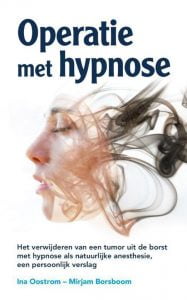

 Much scientific research has been done on meditation, including