
A lightworker is a person who lives from light and unconditional love and shares it. The consciousness on earth can thus be expanded to an even more loving and ‘spacious’ consciousness. This loving energy is also associated with the Aquarian Age and the New Age. A lightworker can therefore sometimes also be called New Age Child or human.
The term lightworker implies that there are also ‘darkworkers’. Although there may be people creating from an intention that is not light (from love) but dark (from fear), our core is always love. Anyone can become/be a lightworker.
Lightworker gifts and characteristics
Below are some characteristics that may belong to a lightworker; these may vary from person to person. You:
Feel drawn to spirituality and other ‘non-earthly’ dimensions.
May have had past lives related to spirituality and/or religion. For example: lives at the time of ancient civilisations such as Ancient Egypt, the Mayans or Atlantis and/or lives as a ‘witch’, priest(s), or nun/monk or lives on other planets/in other cosmoses. If a previous life in which spirituality/religion was central to ended (e.g. due to persecution) and energetically is not yet well-rounded, there may be fear in the present life of working with/coming out for spiritual matters.
Can be highly sensitive and recognise yourself in these highly sensitive persons traits such as: being idealistic, empathising well with another person and being sensitive to stimuli. If you have not yet mastered your high sensitivity, you may take over another person’s energy, lose yourself in helping others (and take yourself away) or not have both feet on the ground. HSP may then isolate themselves.
Love animals and nature.
Want to be of service and help others. Possibly likes alternative care, such as healing.
Feel ‘different’.
Do things individually.
Have an old soul.
Don’t like authority, especially Indigo people have this.
If a lightworker is not yet balanced, this can lead to feelings of misunderstanding and not feeling recognised, loneliness, insecurity or depression, among others.
“Am I a lightworker?” Can you test if you work with light?
There is no science-based test to examine whether you are a lightworker. Essentially, anyone can be a lightworker, if you choose to. You will then recognise yourself in the above lightworker characteristics.
Lightworker training
Life itself offers you ‘training’ to be a lightworker. Other people you meet on earth can help you with this (unsolicited and solicited). Just think of some earthly trainings or courses that support the process on a professional level to work even more consciously from light. You can strengthen and share your light this way. This may be called a ‘Lightworker Training’ or something similar, but it could also be, for example, a course in which you learn to work with energetic tools so you can let your light shine further, or a course in which you learn to master your high sensitivity.
Tip:
Discover who you essentially are and what your qualities are. Let your light shine. This gives energy!
The word intuition comes from the Latin word ‘intueor’. This means ‘to contemplate, stare at or watch intently’. It is a way of perceiving: you can perceive something directly inwardly, without previous experience or reasoning. A synonym is a ‘hunch’, ‘gut feeling’ or ‘sixth sense’.
Female intuition vs men’s intuition
Sometimes people talk about female/feminine intuition, implying that there is also such a thing as a male variant. However: both men and women can perceive in this way. What is masculine and feminine is culture-specific.
Often intuition, like high sensitivity, is labelled as ‘soft’ or ‘feminine’ in Western Society. Especially many men are afraid of being labelled too soft or as ‘weak’. Therefore, they often suppress it. Suppressing who you are can (unconsciously) take a lot of energy and make you unhappy.
In Asia, highly sensitive and intuitive qualities are often more valued compared to the West.
Slowly, this is also changing in Western society. This is related to the Aquarius era.
Follow your intuition!
You can use intuitive qualities for yourself, and also use it to help others:
Intuitive observations can be used as a compass: for instance, it can help you make choices that support you.
Intuitive observations can also give insight into what others (people or animals) need.
Wrong decisions or misunderstandings can be avoided with intuitive observations.
Listen to your intuitive observations helps you to feel good about yourself and to flourish, and to help other persons to flourish too.
Besides, you can do all kinds of other things with your intuitive observations, both in your private life (for example via intuitive drawing or painting) or work life (for instance during coaching). If you listen to your intuitive observations, this is sometimes referred to as ‘effective intuition’.
Inn Saei – the power of intuition
Many people live from their ratio/minds. But there is more than that: intuition! This Icelandic documentary Inn Saei explores it further and inspires you to listen to it.
Watch the trailer here:
I watched this documentary via Netflix.
Intuition test
Put 5 people next to each other and have them look at a painting, and they are likely to see different things. This is because everyone perceives in a unique way. The same applies to intuition; it is unique to each person.
There are tests such as the Zenner test, where you can examine whether your intuition indicates which picture will follow. The ‘danger’ of these kinds of tests is that people can get ‘bogged down’ in the results. Some people may have a very strong intuition, but not on a ‘predictive image level’. Perhaps they are very good at sensing births, or ‘knowing’ what to say in a negotiation meeting. If such a test gives a ‘negative’ result, it doesn’t mean you don’t have strong intuition.
You are the only one who can test whether your intuition is correct! For example, do you dream something that comes true later, have a premonition that it will rain within half an hour and this happens? Then see this as your ‘test’ and ‘evidence’.
Intuition and high sensitivity
Highly sensitive people (HSP) are extra open to stimuli. They often (unconsciously) already have strong intuition. If they do not master their high sensitivity well, they will usually not notice this. Impressions and stimuli can then get so mixed up that they get a full mind and notice few intuitive perceptions.
Types of intuition
Intuition is a perception; it can be a feeling but also, for example, an image. This can be very confusing, as intuitive feelings are quite often confused with emotions. Especially with highly sensitive people who have not yet mastered their high sensitivity, this can be the case. Perceptions of yourself and another person, and from the present, past and future can get mixed up. Therefore, learn to distinguish between wishful thinking, undermining negative thoughts and your intuition.
Developing and trusting your intuition
Like other skills, you can develop your intuition. In some people, this is already a highly developed quality by nature, in which case they are often referred to as having a strong intuition. Compare it to Mozart: he already naturally had a strong musical quality, which he developed further. By practising a lot, he reaped many rewards from this.
So it is also the case with intuition. The more you develop this and learn to trust it, the more intuitive perceptions you will have. There are various ways how you can develop it. For example, some people do this by meditating. Either way, follow your gut if you want to find a way to develop it!
Specifically for highly-sensitive people, it is important that they master their sensitivity so that they don’t get lost in stimuli around them. When you master your sensitivty, you can also distinguish perfectly what is your own or someone else’s energy, for example in terms of emotion. Intuitive impressions become clearer and stronger. It is then easier to develop it.
Psychic intuition
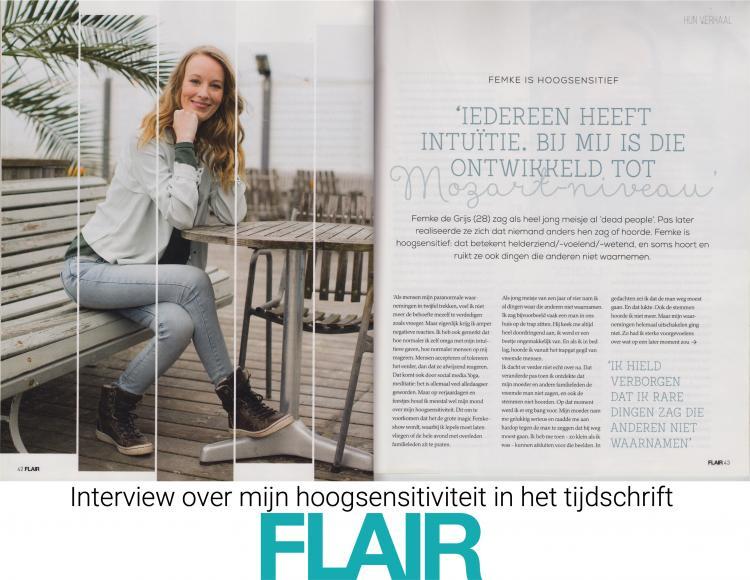
If intuition is developed very strongly, you can have paranormal perceptions. In the dutch Flair magazine, for example, I share more about my paranormal perceptions.
Do you want to know more?
WeI teach you more about this topic and how to strengthen it so that you can benefit from it. You are welcome to contact us.
Have you ever had it: an experience that could not yet be explained scientifically such as seeing colours around people, or a premonition that later turned out to come true? Worldwide, this happens often. It could be related to paranormality.
Paranormal activity
Paranormal means ‘beyond the normal‘. Paranormal activity/experiences are also seen as ‘supernatural’: they involve acknowledging that there is more between heaven and earth.
Paranormal phenomena are often seen as something ‘vague’ or alternative in the rational, down-to-earth West. After all, it cannot yet be scientifically proven. Something many people crave: after all, science provides ‘certainty’. The reality is, however, that scientific knowledge is growing and science is often behind the times: for example, the earth was long thought to be flat.
Taboo
Many people apply the ‘when it is not scientifically proven, it does not excist’ principle. Observations that are not so ‘standard’ or ‘normal’ are often brushed aside as ‘nonsense’. Many people who observe paranormal phenomena do not dare to talk about them because they feel they are not accepted:
Perhaps you are afraid that others will find you ‘different’ or weird and you are ashamed of your impressions?
Maybe you suppress it (e.g. because your environment has a religion that disapproves of paranormal perceptions)?
Especially highly sensitive persons who have not yet mastered their high-sensitivity can be extra sensitive to the (unspoken) opinions/expectations of others and the ‘taboo atmosphere’ surrounding this topic. Especially if you are ‘living’ in your head a lot and are realistic by nature, paranormal perception can be challenging. Do you fret about whether or not to show your paranormality to the outside world? This can make you tired.
Paranormal stories
Fortunately, more and more about paranormal activity is slowly being shared in the media. ‘True’ or not ‘true’ (sometimes it involves magic tricks and entertainment); the fact remains that more attention is being paid to this subject.
For instance, I talked about my paranormal observations in the dutch Magazines: Viva magazine, Vriendin, the Dutch magazine Flair and Belgian magazine Flair.
Crazy Wise
If you hear voices, have lucid dreams or visions or other paranormal perceptions, this is often labelled ‘crazy’ from Western culture (sometimes people are given all kinds of diagnoses such as depression). This is in contrast to other cultures.
The film CrazyWise delves into this. Although I found the film very intense and confrontational, it is an absolute must-see if you are highly sensitive and you suffer from your sensitivity.. This is the film’s trailer:
25 signs that you have psychic abilities
Here are some examples of signs that may come with being paranormal. Just as painters and their talents are unique, paranormal gifts also vary from person to person.
Psychic power
What is a psychic gift?
A gift (sometimes seen as a gift from the Cosmos or Source), is also called a quality or talent; there is aptitude to develop it further. If you master your psychic gift you can recognize yourself in these phenomena:
Paranormal phenomenon 1. You hear sounds that others do not hear
Paranormal phenomenon 2. You feel energy fields or auras You perceive colours in people or animals, for example.
Paranormal phenomenon 3. You get information from an object For example you can receive information about the owner of the object.
Psychic phenomenon 4. You have insight into the past and past lives
Paranormal phenomenon 5. You have insight into parallel lives These are events that happen simultaneously (parallel) to your life. You may experience that you are in different places at the same time.
Paranormal phenomenon 6. You have insight into the future and can predict things Perhaps you perceive that a soul chooses its parents and wants to be born, what an unborn child wants to be called, or when/how a child will be born.
Paranormal phenomenon 7. You see ghosts like faces or phantoms or perhaps altogether. There are different definitions of what exactly ghosts are. These can be deceased people you know, but also strangers. These are sometimes called entities. Usually, entities are known because people have unpleasant experiences with them in specific places (such as in the home). Perhaps you have felt someone bending over you or moving a specific part of your body.
Paranormal phenomenon 8. You feel light beings, ascended masters, guides or help ‘from above’ This can also be from other galaxies or cosmoses. Perhaps a spiritual guide or guardian angel feels like a special friend no one else can see.
Psychic dream
Paranormal phenomenon 9. You have dreams in which guides or people give you clear messages Perhaps during your dreams you gain insight into ‘why you are here on earth, what choices strengthen you and your soul or why you experience things (e.g. because they are based on unfinished past lives).
Paranormal phenomenon 10. You are aware of out of body experiences Your body is present on earth, but your consciousness somewhere else. For example, you are lying in bed and you are stepping out with your consciousness into the dream dimension or another country. Perhaps you feel like you are flying.
Paranormal phenomenon 11. You know what the other person is thinking For example, you can sense an animal well and make telepathic contact with it (‘talking’ through the air), or see pain. This goes even further than thinking of someone and that person calling you: you know the other person is calling!
Paranormal phenomenon 12. You can move objects with your thoughts This is also known as telekinesis.
Paranormal phenomenon 13. You can ‘channel‘ Or to be a channel of unconditional love. Maybe you do automatic writing to pass on messages from loving light beings, for example.
Paranormal phenomenon 14. You enjoy working with energy in more ‘alternative ways’ For example, through gemstones or oracle cards.
If you have not yet mastered your paranormal gift, you may recognize yourself in these phenomena:
Paranormal phenomenon 15. You experience (intense) sounds or voices that others do not hear.
Paranormal phenomenon 16. You have unexplainable emotions (such as fear), thoughts or certain behaviour. These may have originated in other times (past lives, parallel lives or future lives).
Paranormal phenomenon 17. You take things ‘over’ Maybe you get sick of a certain room containing negative energy (e.g. because there has been an argument), or you take over another person’s pain or loaded emotions.
Paranormal phenomenon 18. You have difficulty distinguishing what is your own or another’s energy For example, in terms of thoughts, emotions or physical pain and times (past lives, present and future).
Paranormal phenomenon 19. You get tired of other people’s pain
Paranormal phenomenon 20. You are afraid of what you perceive For example, you are afraid of ghosts. You feel that your body, emotions or thoughts are being pushed/moved in a certain direction without your control.
Paranormal phenomenon 21. You don’t allow your paranormality Maybe you suppress it and you ask yourself what you want/can or ‘should’ do with it.
Paranormal phenomenon 22. You do not feel supported
Paranormal phenomenon 23. You have no control over your sleep/dreams Perhaps you feel you have no control over your sleep and dreams. Perhaps you have intensely confusing dreams and/or nightmares? Or maybe you suffer from sleep paralysis? This means that although you are conscious (and in that sense awake), your body is asleep. Your body is not doing what your mind wants: waking up, opening your eyes and stretching or moving yourself. This can sometimes feel like you have ‘stepped out’ and cannot ‘fall back’ into your body. Because you have no control over your body and may feel like you are ‘trapped’ in your body, this can lead to panic or anxiety.
Paranormal phenomenon 24. You are afraid of others’ opinions It bothers you that others think you can ‘see through them’.
Paranormal phenomenon 25. You feel that you have lost yourself
Psychic testing
There are various tests to investigate whether you are paranormal such as the Zenner test. The ‘problem’ with these tests is that they often highlight one aspect (in the case of the Zenner test: perceiving an aspect of the future) and are often done by people who have not yet mastered their gift. A test may reveal that you do not have a psychic gift, even though you have this predisposition.
Paranormal therapist
There are all kinds of people who consciously work in a paranormal way such as at a paranormal fair. For example: a paranormal therapist (and paranormal therapy), paranormal healer and paranormal medium.
There are also relatively many people who work with their psychic gift, but (un)consciously do not name it as such. This is usually because they are afraid of what those around them might think of their paranormality, or out of modesty.
Do you have paranormal gifts? 8 tips:
Tip 1. In case of complaints: consult a doctor too
Choose a doctor you feel comfortable with (e.g. one with a holistic point of view).
Tip 2. Investigate whether you are psychic
You can do this by feeling about this or by asking for our help.
Tip 3. Acknowledge your paranormality
Are you paranormal? Acknowledge it: it is a part of you! Another does not have to accept you; accept yourself.
Tip 4. Get closer to yourself and stay in your own energy
Learn to protect yourself properly, so negative energy does not have an impact on you.
Tip 5. Cleanse negative energy
For example, cleanse negative energy in your home and in yourself. Learn to transform fear.
Tip 6. Learn to let go of perfectionism and insecurity
Tip 7. Let your (psychic) dreams work for you
Do you suffer from sleep paralysis/(psychic) nightmares? Discover the cause (and why it happens) and remove the cause. Learn to direct your dreams, this can be done through lucid dreaming. Do you suffer from sleep paralysis? Femke can help you with this.
Tip 8. Develop your paranormal gift
You can develop your paranormal gift for example with the help of light beings. Making your gift work for you gives you energy. With your paranormal gift you can also do wonderful things for the world around you and make the world more beautiful, in your unique way. Show yourself!
Being an introvert, what exactly is it? Find out in this blog and also how to turn this into a strength as a Highly Sensitive Person, with inspiration from Susan Cain!
Introvert meaning
According to the dutch dictionary ‘Van Dale‘, introvert is “introverted” and “not very talkative”. The opposite of introvert is extrovert.
Every person has both sides in them. You often recognise yourself either more in introverted behaviour, or more in extroverted behaviour, sometimes both.
Introvert traits
Introversion can express itself in thoughts (and how you make decisions), feelings and behaviour (such as how you deal with stimuli and communicate). An introvert may recognise themselves in these traits:
Behaviour of an introvert
Introverted behaviour consists mainly of Yin energy: that which we often call ‘feminine’ in our Western society:
You like to be in the background, rather than in the foreground.
You act quietly; for example, you don’t want to share what you are working on until it is finished.
Introverted thinking
You contemplate, e.g. before you say something.
You can observe well.
You can be very focused.
You can be creative, you have creative ideas, for example.
Relationship with yourself/others as an introvert:
You like to be alone.
You like to do things alone or with one other person together.
You go for quality rather than quantity in terms of friendships: you prefer to have a few good friends, rather than many ‘half’ ones.
You prefer talking one-on-one rather than in a large group.
You like in-depth conversions (rather than smalltalk).
You are a good listener.
You like to express yourself in writing, rather than verbally/telephonically.
Hypersensitivity
About 1 in 5 people is a highly sensitive person (HSP) and recognise themselves in these HSP characteristics. Basically, there are 2 different HSP types;
the HSP ‘peace-seeker’, who behaves more introverted.
The HSP Sensation Seeker, also called High Sensation Seeker (HSS), who behaves more extroverted. An HSS likes to seek out many stimuli in the outside world more. This behaviour consists mainly of Yang energy: that which we often call ‘masculine’ in our society.
Introvert or extravert
Besides the HSP peace seeker and sensation seeker, there are also non-highly sensitive people, who are introverted or extroverted.
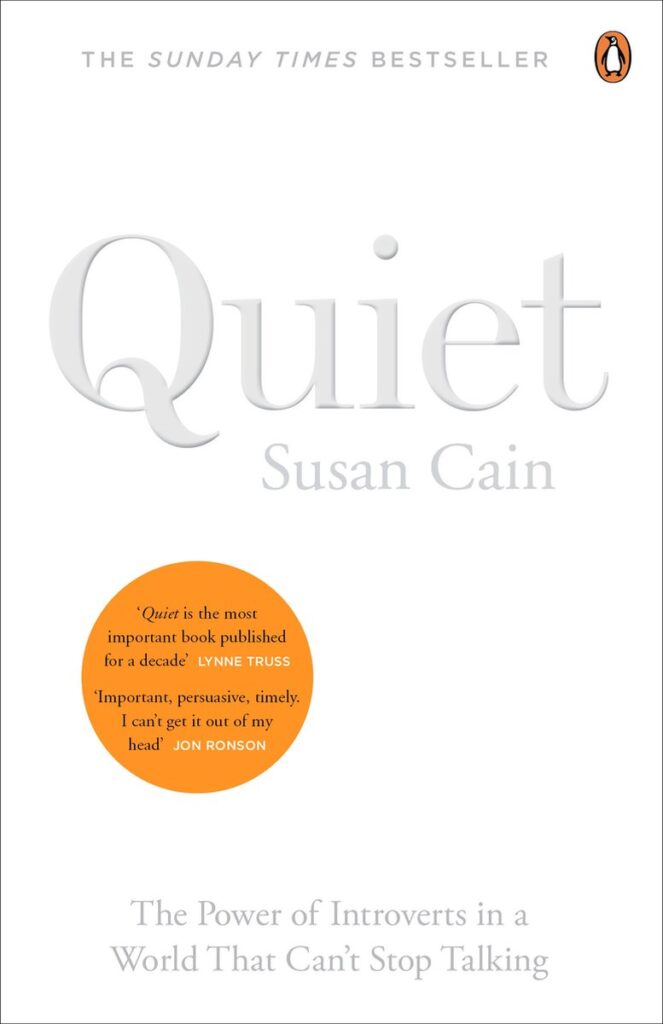
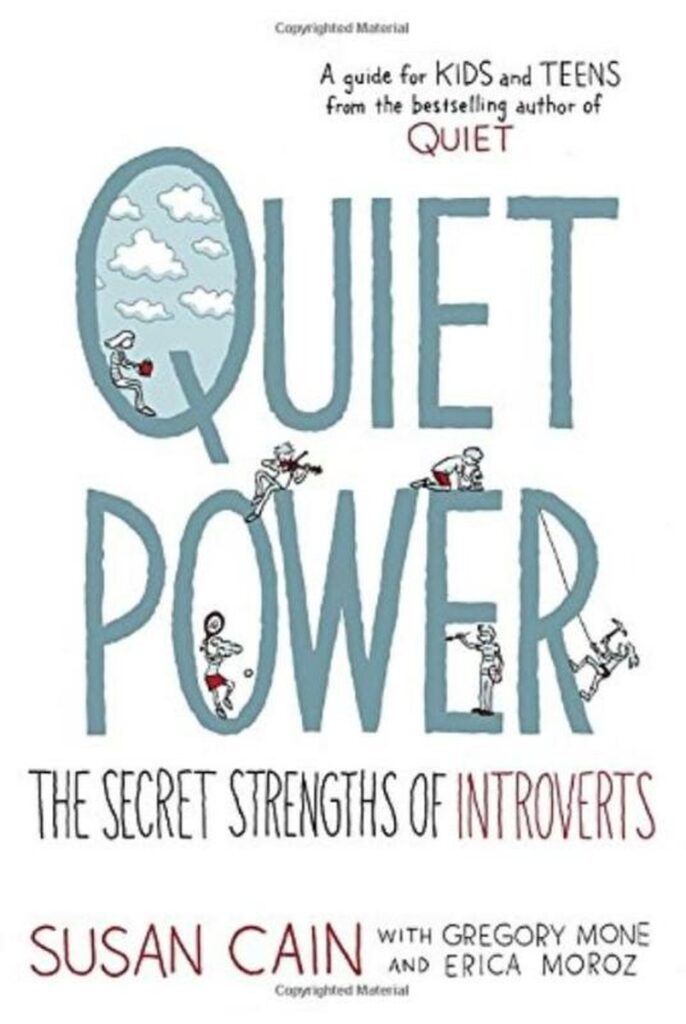
Quiet – the power over introverts (Susan Cain)
In this Ted Talk, Susan Cain talks about introversion and the qualities of introverted behaviour. Tip: use these qualities, they give energy!
We collaborate with bol.com. This article therefore contains affiliate links. If you order this book/something else at bol.com via the links in this article, we will receive a small compensation for this and you will support me. I really appreciate this! You pay nothing extra.
Suffering from introversion and fatigue? Tip:
Are you highly sensitive and introverted?
Learn to manage your high sensitivity and use it as a strength and to stay in tune with yourself and your own energy. That way, you will no longer suffer from introversion, conflicts and fatigue.
Spirituality is derived from the Latin word ‘spirit’ meaning ‘mind’. Central to this is becoming and being aware with your mind (thoughts) of yourself (and, for example, your meaning, motivation and qualities) and what gives meaning to your life.
With your mind you can cooperate with your soul, core or true self, which has its origin in another (not earthly) dimension. Some people experience this “other” dimension as divine. Someone who lives spiritually acknowledges that there is more between heaven and earth.
Spirituality involves living a soulful life; this includes living from unconditional love.
Developing spirituality
Spirituality is a personal experience. Supernatural powers can be experienced, such as in near-death experiences, paranormal observations, intuitive experiences, and the perception of light beings.
There are many ways to live spiritually and to develop spirituality. Which way suits a person is very personal. For example, many people meditate, or enjoy silence to experience their spirit and themselves.
You can also reflect on life questions such as ‘why am I here on earth?’ and ‘what is my purpose on earth?’ and reflect on thoughts, feelings, and experiences. These pursuits are nourishing for the mind (spirit) and Yourself, just as food and drink are nourishing for the body. In any case, choose something that makes you happy and feels good, even if it is just doing the dishes or going for a walk!
Spirituality test
Everyone is spiritual; after all, everyone has a spirit. However, not everyone lives spiritually. There is no scientifically validated test to examine whether and to what extent you live spiritually.
You can ask yourself:
To what extent do I experience purpose, fulfillment and inspiration in my life?
To what extent am I aware of my motivation?
To what extent am I aware of my qualities?
To what extent am I honest, for example, about my wishes?
To what extent do I contemplate life questions such as: who am I, where do I come from, and what is my purpose on earth?
To what extent do I experience that there is more between heaven and earth?
To what extent do I experience Myself?
To what extent do I live from unconditional love?
To what extent do I experience self-confidence?
To what extent do I experience abundance?
To what extent am I in service to myself and others?
Spirituality is not:
Being dishonest and suppressing your desires
Being positive and ignoring negative things
Pretending everything is love
Only thinking of yourself
Misconception about spirituality
It is a misconception that spirituality always relates to religion and ‘faith’ and that it is airy-fairy. Spirituality can also be practiced with religion and means standing firmly with both feet on the ground.
Spiritual guidance
Spiritual guidance usually refers to guidance from subtle dimensions, such as from Ascended Masters.
Spiritual help
Various professionals offer spiritual help, for example a:
Spiritual medium
Spiritual reader (who can offer a spiritual reading)
Spiritual advisor
Spiritual therapist
Spiritual director
Spiritual teacher
Spiritual entrepeneur
The way spiritual professionals offer varies. For example, there may be offered:
Yes, it is april 2022 and we have a puppy! In this article I share more about it :).
I love dogs. That has not always been the case. As a child I liked them until I was bitten by a small dog. I became afraid of dogs.
Fear of dogs
When I studied Applied Psychology I got to know Schapendoes Aagje. A Schapendoes is a dutch breed, loosely translated as; dutch Sheepdog. Aagje got me over my fear of dogs. She regularly stayed with me and I became a Schapendoes fan!
Then it was time for a ‘own’ dog; I am grateful that Schapendoes Otje has been in my life for eleven years.
After that we wanted a Schapendoes (a girl) again; timing wise, we decided to listen to our gut.
A puppy from Sweden 🙂
Mathijs and I have been traveling the world indefinitely since 2017. We are currently in Sweden. Here came a litter with 3 Schapendoezen on our path, including 1 girl. Below I share some pictures and more about her character and her name:
Schapendoes puppy 4 weeks
We met the puppy when she was 4 weeks old (many breeders in Scandinavia do this).
This is our first photo together!
She is now black and white with sporadic gray hairs (there is a chance it will stay that way).
Her eyes are still blue, over time this color changes (they are expected to turn brown).
Schapendoes puppy 5 weeks
Schapendoes puppy 6,5 weeks
We arrive in the evening. The girl (on the right in the photo) falls asleep on my lap. It’s my lucky night :). I hold her in my hands (the black/grey puppy on the left that moves is her brother).
The next day the puppies are introduced to our motorhome. The puppy lying against the fridge is the girl.
Character Schapendoes puppy
When we visit her, the puppy is usually the first to wake up and the last to go to sleep. She is more active, curious and inquisitive compared to her brothers. Ze loves to discover the world just like we do. If she was human, she was probably a (digital) nomad ;).
We are grateful that the breeders entrusted us with this girl and she is our new puppy. A perfect match! We are very happy with this. We picked her up on Saturday, April the 2nd, 2022.
Announcement of here name!
How we came up with the name
Before the puppy was born I had made a list with possible names. In the course of time and after the meeting with the puppy, this has expanded considerably.
The puppy was born in Sweden in Skäne. When we got to know her we were staying in Småland. We regularly spend the night with the camper on the coast near the puppy, so that we could admire her for several days.
The name came to me through a lucid dream
During one of those nights, I had a lucid dream (a dream in which I became aware that I was dreaming while my body was asleep). I decided to investigate what name we could give her. I got through five names. Many of those names were on my very first list and we had already discussed. One name had my preference right away in my dream.
When I woke up I shared the dream and the name options with Mathijs.
We are happy to share the name:
It has become Juultje!
How did the first week go?
We picked up Juultje with our motorhome and she made her first trip with us! The travel went fine. We took regular breaks. At some point she fell asleep.
When she first entered our temporary home, she acted as if she had lived here for years.
She likes to be around us.
Juultje likes to discover new things, such as our temporary garden. Here she regularly hops around happily.
For example, she sniffs and plays with leaves and twigs and digs open molehills a bit. Her white paws remain surprisingly white.
She is also introduced to various weather conditions such as rain and snow.
Juultje is almost newspaper-trained.
We teach her to pee outside. Sometimes this goes well :).
We do our best to socialize her optimally and, for example, to introduce her to stimuli (such as other dogs and people) that she will also have to deal with in the future. She also sleeps a lot, so everything can be processed well ;).
We think Juultje is a fantastic puppy and we are grateful that she came into our lives :).
[nv-custom-layout id=”1639″]
Everything is energy. Disturbances or blockages of energy can cause accumulations or shortages of energy in various places, which can manifest as physical, emotional and/or mental complaints (this can sometimes be diagnosed as a disease).
Healing can take place in various ways. Surgeons often heal the body by literally cutting into it (via surgery). There are also other forms of healing. For example, regular psychologists often work on healing on a mental level. Usually, healing refers to a healing that balances your soul (spiritual core), thoughts, emotions and body. Here you will find more forms of healing.
Effects of healing
The effects on the physical, emotional and mental level of the client can be noticed immediately or in the long term (for instance after several sessions). Symptoms may decrease and possibly disappear.
However, it is a great misunderstanding that healing always means a literal cure, that the cause of the illness is removed and the complaint 100% disappears. Although this is possible, it is not the goal of healing: the goal of healing is to bring someone back into contact with himself/herself and to let his/her soul energy flow optimally again. So that someone is comfortable again, and can deal with what is present.
Therefore, always consult a doctor in case of complaints: healing is a form of alternative health care and an addition to regular care (it is not a replacement).
Giving or receiving healing?
You can either give or receive healing.
Giva a healing
If you want to give a healing, it is advisable to follow a good training in this. In this way you can prevent yourself from getting exhausted during or after giving a healing and the person you are giving the healing to will feel worse instead of better. Someone who is professionally trained to give healing is called a healer.
What is a healing session?
A healing session is a contact moment in which healing takes place; a healer gives healing to the receiver. This can take place in real life, but also at a distance.
Usually a healing session takes place individually (1 on 1), but it can also take place in a group. Usually this is called group healing.
Are you looking for a healer or healing training? Tips:
Choose a healer/healing education:
Who feels comfortable. Each way of healing resonates with a different energy/frequency; choose something that makes you happy. The energy of healing also works ‘at a distance’, therefore a healing (training) can be given in real life and online.
Who works ethically and respects your boundaries and free will and choice. For example, it is not okay if someone gives you unsolicited (remote) healing without your physical and literal consent. This is energetic trespassing. HSPs can (unconsciously) suffer from this. In a good healing training you will learn more about this, also what you can do if you want to heal someone who cannot speak (such as a baby, someone in a coma or an animal).
Forms of healing
Healing can take place in all kinds of ways and can consist of various steps. A well-known form of healing is Reconnective Healing. Find out more about it below and go to:
A form of healing is Energy healing (formerly: Esoteric healing). This is given among others by the NNEH (Nederlands Netwerk Energy Healing) and INEH (International Network for Energy Healing).
Energy Healing is based on the ideas of Ascended MasterDjwal Kuhl. Djwal Kuhl is also called ‘Tibetan’. He has lived on earth before, and is thought to have reincarnated earlier than King Caspar (one of the three saints who gave Jesus a gift), philosopher Confucius and philosopher Lao Tse (also called Laozi).
An Energy Healing therapist is trained to perceive energy and imbalance. The healing is focused on discovering the causes of the complaints, rather than fighting the symptoms.
The therapist’s intention is to trigger the self-healing capacity of the client, so that their soul energy can flow to where it is needed. No energy is added to or taken from the energy of the therapist. In contrast to Quantum Touch the client is not touched, but work is done at ‘distance’ (this can also be done literally from different parts of the world).
Energy Healing experiences
Femke: “I followed the course Energy Healing, it taught me how I could work consciously and practically with energy. I found it a real ‘do- and experience’ training. Later I discovered that there are many more ways to heal.
For example, in this training soul consciousness was very central; there are also other forms of consciousness that can be very effective for healing. I also missed learning to work deeply with light beings.”
Healing in lucid dreams
Lucid dreams are dreams in which you are aware that you are dreaming while your body is asleep. You are face to face with your unconscious. Here you can engage in healing on a profound unconscious level.
Some people see high sensitivity as a disease, or as something you have to get rid of; this is a misunderstanding. High sensitivity is a quality, but can be a burden if it is not well managed yet. Maybe you are easily over-stimulated or tired as a HSP. Healing can support you in this, but it is not the solution.
It is a misunderstanding that high sensitivity problems can be solved by someone else such as a healer. Some HSP for instance become dependent on a healer.
If you suffer from high sensitivity problems, you have to start working with yourself.
Animal healing
Healing can be applied to humans, but also to other living beings such as animals.
Ascension Tools
Ascension Tools are glass light instruments/products that resonate with the energy of Atlantis. They can easily be used to give a healing, for example to adults, children and animals. Some HSPs use them to shield themselves better and to stop being bothered by entities or electromagnetic radiation.
Discount code for Ascension Europe
We collaborate with Ascension Europe. This article therefore contains affiliate links. If you order something from Ascension via the links in this article, we will receive a small compensation for this and you support us. We appreciate this very much! You don’t pay anything extra.
Are you going to order something from Ascension Europe for the very first time? Tip: use the discount code: mathijsvanderbeek and get a 3% discount on your product(s) (this code does not work in combination with other codes/promotions and will not be applied to any shipping costs)!
What is a healing environment?
A healing environment is an environment that has the intention to support people both professionally and privately and to prevent complaints such as stress. Physically, emotionally and mentally. Just think of:
people in a hospital. The term is best known for its use in healthcare.
a family in a house.
employees in an office.
A healing environment can consist of elements that can also be found in nature, such as:
photos of nature
plants (preferably real ones (instead of artificial ones)
silence
an electrosmog free environment (internet on a cable, instead of WIFI)
clean air
daylight
special colors (such as green)
It can also consist of:
inspirational magazines in a waiting room
a ‘waiting line’ so that people feel they have privacy
Slowly the Chinese man walks in my direction. I know he wants to kill me and I feel an oppressive fear. In the past I would have fled, or woken myself up by screaming. Now I realize that I am dreaming, while my body sleeps. I choose to surrender to the dream, let the man come to me, observe how fear flows into my dream body, and let the man do what he wants to do. Suddenly the man takes me to a totally different dream scene. The fear is gone. When I wake up I feel strong and realize that my core is immortal. These kinds of dreams have not only changed my dream life, but also my waking life for the better. And they can change your life too!
What are lucid dreams?
Lucid dreams are dreams in which a person is aware that he/she is dreaming while sleeping. The word lucid is derived from Latin (lucidus) and means luminous, clear and bright. The term lucid dreaming was coined in 1913 by the Dutch psychiatrist Frederik van Eeden, who often dreamed lucidly. Lucid dreaming has been scientifically proven, among others by Dr. Hearne and Dr. LaBerge.
Why would you want to have lucid dreams?
Your subconscious determines for approximately 95% your life, including thoughts, feelings, emotions and actions. Lucid dreams offer you the possibility to stand eye to eye with your subconscious and communicate directly with it.
In a lucid dream you can exercise influence on a dream. Lucid dreams help you to let your unconscious work to your advantage during the night and during the day, so that you can have a pleasant (dream) life.
Approximately 33% of your life is spent sleeping, of which approximately 25% is spent in the dream state. When you reach the age of 90 you will have been dreaming for an average of 7,5 years. How do you want to organize this time? There are several reasons for lucid dreaming, these are connected to the advantages of lucid dreaming.
Advantages of lucid dreaming
Lucid dreams have numerous physical, emotional, mental, relational and spiritual benefits, these are some examples:
General benefits of lucid dreaming
Lucid dreams can give you strength and inspiration, help you to wake up pleasant and energetic and give you a grip on your dreams.
With a lucid dream you can discover the meaning of your dreams. The meaning of a dream can be very different from what you have thought up with your conscious mind in your waking life, because you are now communicating directly with your unconscious.
Furthermore, lucid dreams can help you to be more creative, to make your daily life easier and to experience a more pleasant daily life. They can provide insight, for example in how you use a talent (such as high sensitivity) better or what energy guzzlers are and how you get more energy.
In addition, in a lucid dream you can support yourself on a deep, unconscious level with energetic healing on a physical, emotional and mental level. Mr. S. had 22 years of chronic pain, which completely disappeared after a lucid dream. In case of complaints, always consult a doctor.
Physical benefits of lucid dreaming
Lucid dreams have physical advantages. For example, in a lucid dream you can be engaged in activities that you cannot do in waking life. If you have a physical limitation, you can often make use of what limits you in your daily life in a lucid dream. Think of limitations of your eyesight or limbs and such.
Furthermore, in a lucid dream you can learn to improve skills from your waking life, such as playing sports, making music, giving a presentation or practicing an important conversation like a job interview. Research shows that practicing motor skills and sports in a lucid dream can lead to improvements in these skills in waking life.
You can also plant energetic seeds that will help you attract abundance in your waking life.
Emotional benefits of lucid dreaming
In a lucid dream you can do what you like and enjoy it. Lucid dreams can help to create emotional balance. For example, you can resolve worries, transform emotions such as fear and gloom and overcome nightmares. Some scientists suspect that lucid dreaming is a good remedy for (recurring) nightmares. There are studies that confirm this thought (like this study and this study). With lucid dreaming you can increase self-confidence, overcome shyness and find happiness.
Mental benefits of lucid dreaming
Lucid dreams have mental advantages. They can support you to make choices that really suit you and solve problems. A study found that people who dream lucidly are better at solving problems in the waking world. Lucid dreaming can help you profoundly transform your mind and limiting beliefs and create more flexibility and adaptability.Furthermore, you can develop your focus and concentration skills. If you like to meditate, then you can improve your meditation skills.
Relational benefits of lucid dreaming
With lucid dreaming you can improve relationships and resolve any conflicts, even with people who have passed away. You can help others. You can also develop empathy and compassion; for others and yourself.
Spiritual benefits of lucid dreaming
Lucid dreams can help you to develop your consciousness, to experience oneness (instead of loneliness and separation), to come to yourself, to ‘anchor’ in yourself and to live from your core.
Some people experience through lucid dreaming that there is more between heaven and earth, which helps them to transform fear of death.
Furthermore, with lucid dreaming you can thoroughly purify karma (such as undermining thoughts, emotions, actions and habits). Furthermore, lucid dreams offer you the possibility to experience contact with light beings (such as angels and ascended masters) on a subtle level and to receive inspiring teachings from them. In a lucid dream you can also communicate with deceased people and help souls who are stuck or confused in the afterlife.
History of lucid dreaming
Lucid dreaming has been taught and applied in many cultures and religions for centuries, for example by the ancient Egyptian civilization, various ‘primitive’ tribes and Hindu, Taoist and Buddhist religions.
Tibetan Buddhism (such as the Dzogchen tradition) considers dreams very important: they see lucid dreaming as a possibility to develop consciousness, through which one can become enlightened. For Tibetan Buddhists, developing this mastery is the main purpose of dreaming.
After lucid dreaming was scientifically proven around 1980, more and more research has been done on it over the years. Sleep clinics around the world are interested in these dreams. They train dreamers to have these kinds of dreams. The science surrounding lucid dreaming is relatively in its infancy. The studies that have been done are often promising and invite further research.
Misunderstandings about lucid dreaming
There are many misunderstandings about lucid dreaming. Some people think that taking the lead in dreams goes against a purpose of dreaming – learning something and gaining insight into yourself/others. This is a misunderstanding: lucid dreaming is a natural phenomenon. There are even people who only lucidly dream. Lucid dreams give you the possibility to be in direct contact with your subconscious, to get insight in it and to learn something from it. In this way you can get to know yourself.
Sometimes the objection is raised that one can get stuck in a lucid dream, that one would rather dream than be in the waking ‘real’ life, or that one can no longer distinguish well between the waking life and the dream life. This is where you have a choice.
There are people who think that lucid dreaming costs a lot of energy and makes one tired, this can only happen if you don’t dream lucidly in the right way.
Besides that, some people are afraid that lucid dreaming will make them ‘floaty’. When you’re lucid dreaming in the right way, you keep both feet on the ground.
There is no scientific evidence that these dreams are dangerous.
These dreams help you to live life to the fullest and to get the most out of the time that you are on earth (during the day and night).
Fear in lucid dreaming
Furthermore, many people cannot cope well with fear in their lucid dream. This can manifest itself, for example, in running away from or sending away what they are afraid of.
It also happens that people know they are dreaming and are afraid of something in their dream, think that what they are afraid of is “real”, and then don’t want to dream or sleep at all to avoid fear. This is not an effective way of dealing with fear.
After all, the thing that evokes the fear continues to exist. It can cause the fearful dream to return. Anxiety is there for a reason: it is important to investigate this thoroughly and resolve the reason for the anxiety.
How to have lucid dreams? 3 steps!
Everyone can learn to dream lucidly, it only requires motivation, perseverance and time. About one out of five people is a highly sensitive person (HSP). Highly sensitive persons have a relatively open aura/energy field and a strong intuition. They have a predisposition to work easily with subtle dimensions (such as the dream dimension) and to train their thoughts and consciousness. This will help you learn to dream lucidly.
Even if you don’t have any or hardly any dreams, you can learn lucid dreaming.
The only people who sometimes cannot lucid dream are those who have had a stroke.
Keep in mind that learning to dream lucidly is not suitable for everyone. If you have mental complaints such as a depersonalization disorder or complaints in which you lose the feeling of reality (for example a psychotic disposition or dissociative disorder), then consult a mental health professional whether you can engage in lucid dreams.
As an addition (not a replacement) to the regular health care you can sometimes use lucid dreaming to support yourself with psychological and psychiatric complaints. Do this only with the help of an expert. Some people use lucid dreaming for example to support themselves to solve a trauma or depression, or to better deal with their personality disorder.
Be patient: often it takes time to get lucid dreams. About 20% of the population has an average of one lucid dream per month. An average practitioner has on average one lucid dream a week, a single intensive practitioner can have it daily.
You get these dreams when you are ready. Choose a dreaming method and vision that fits you and feels good. Many methods consist of tricks. Below you’ll find a global step-by-step plan that will help you to lucid dream.
Step 1: Ask yourself why you want to dream lucidly.
Maybe you want to have lucid dreams:
to develop yourself and your dream skills?
to get new ideas that you can apply to your waking life?
to experience more control, for example over nightmares.
Step 2: Learn to remember your dreams.
Keep a dream journal and record all the dreams you remember for about two weeks.
Step 3: analyse your dreams: what comes back often?
Write it down in your dream journal.
Step 4: Go to sleep prepared.
Before you go to sleep, say to yourself in your mind, “If I have to deal with topic X again (something you dream about often), I’ll remind myself that I’m dreaming.” This will help you become lucid.
From a spiritual point of view, lucid dreams are more than a trick; they offer you the opportunity to get in touch with your essence and develop yourself.
Can you use substances to get lucid dreams?
There are several external agents that support, stimulate and give lucid dreaming. Examples include gemstones, sleeping masks and electrodes that can be stuck on specific places on your head. There are also resources that you can take, such as herbs.
Substances that you take or stick on your body to dream lucidly have disadvantages. Herbs and electrodes can be experienced intensely by people and can also cause (long-term) side effects, for example if you are (unconsciously) intolerant to an herb.
Moreover, in this external way you create lucid dreams when you might not be ready for them. Compare it with wanting to experience relaxation: you can learn this yourself with your mind, without resources. There are people who take external resources to experience relaxation, such as alcohol. There is no need to ingest or apply any drugs to lucid dreaming to dream lucidly.
From a Tibetan Buddhist view, the atmosphere when you are dead is very similar to the dream atmosphere. Tibetan Buddhists train their mind and consciousness so that they are lucid and recognize that they are dreaming at the moment they dream. The applicable idea behind this is that over time you will also recognize more easily that your body is dying/dead, making it easier for you to go to the light and achieve enlightenment. Also, when you transition to another state of being, you don’t have herbs and the aforementioned physical means with you.
Your mind is powerful enough to learn lucid dreaming on its own. You can train your mind and learn lucid dreaming with a course that suits you and by surrounding yourself with like-minded people who are into this. That is a safe and nourishing way.
You can find more information about the research of LaBerge here: LaBerge S.P., Nagel L.E., Dement W.C., Zarcone V.P. Jr. Lucid dreaming verified by volitional communication during REM sleep. Percept Mot Skills. 1981 Jun;52(3):727-32. doi: 10.2466/pms.1981.52.3.727. PMID: 24171230.
[nv-custom-layout id=”1639″]

Femke: I love to work with lucid dreaming and have been trained in this. I like to share my knowledge with you, for example in the dutch lucid dreaming course for HSP. Do you want to know more about this in English? Contact me.
Are you waiting for surgery as a highly sensitive person (HSP) and do you dread this? For example, are you stressed over and nervous, or afraid that something will go wrong? Do you worry about it, do you wake up at night and get tired of it? HSP have a more sensitive nervous system and recognize themselves in these HSP characteristics. They can experience stress and nerves more intensely compared to non HSP. These tips will help you further!
Tip 1. Know what to expect
Prepare well. Why is the operation necessary? Having a goal provides motivation and helps you keep going, even if you are experiencing heavy emotions, like fear. Choose medical doctors you trust. What exactly will happen before, during and after surgery? Which substances and medication are being administered to your body? HSP can experience this more intensely compared to non-HSP. Also keep in mind that the anesthetic nitrous oxide (N2O), when used chronically, leads to a vitamin B12 shortage . If you have a absorption disorder of vitamin B12, you can, for example, investigate whether there are alternatives to this. Some HSP may suffer months of burden of the anesthesia. For example, they are tired, restless, sleep worse, are emotional (scared) and / or suffer from mood swings. Sedation can sometimes be an alternative. Also, practicing lucid dreaming can help.
Tip 2. Ask for help
Perhaps loved ones can give you a lift to the hospital, burn a candle for you during surgery or take you home after surgery and do some household chores or cook some goodies? You can also ask for help to light beings (like ascended masters) , for example, that you are relaxed before the operation, that the operation is positive and you recover well.
Tip 3. Learn to transform any fear
Discuss your anxiety with the doctors and nurses. Learn to transform it.
Tip 4. Relax
Meditate for example and/or use the Tool of Calming. Self hypnosis can also help you relax: at tip 10 you will find more information about this. Are you afraid of needles? Then check out these tips (this article is Dutch: you can use Google Translate in Chrome to translate the text). Take things like pajamas and slippers that will make you feel relaxed.
Tip 5. Stay close to your own energy and essence
Shielding prevents you from getting energy from others like loved ones, other patients (who may be scared or uncertain) and take over doctors.
Tip 6. Let go and trust
Can you read Dutch? For inspiration I share an interview with the Dutch Magazine Viva about controlfreaks. Do you find letting go and trust difficult? Find out why (for example, this may have originated in a past life) and learn how to transform it.
Tip 7. Bring something to look forward to after the operation
Do you have books or magazines that you like? Or a movie you want to see for a while? Take them with you so you can focus on something positive after surgery. This gives energy instead of worrying about recovery and the like. Need inspiration? Here you will find my Dutch book tips for HSP (some titles are also available in English).
Tip 8. Cleanse your body energetically
Have you had the surgery? Release energy that you do not serve, such as from substances that have been administered to you. For example, drugs used for anesthesia can lead to drowsiness and concentration problems. For example, drink water that is energized.
Ask doctors what you can do to promote your recovery. Also support yourself energetically, for example with the Flame from Ascension Europe. This is an addition to regular care (not a replacement).
Discount code for Ascension Europe
We collaborate with Ascension Europe. This article therefore contains affiliate links. If you order something from Ascension via the links in this article, we will receive a small compensation for this and you support us. We appreciate this very much! You don’t pay anything extra. Are you going to order something from Ascension Europe for the very first time? Tip: use the discount code: mathijsvanderbeek and get a 3% discount on your product(s) (this code does not work in combination with other codes/promotions and will not be applied to any shipping costs)!
Tip 10. Be inspired by hypnosis
HSP can benefit a lot from hypnosis. Below you will discover:
What hypnosis is
What the benefits of hypnosis around surgery are
For whom hypnosis around surgery is suitable
Which medical doctors use hypnosis for surgery
Whether /how hypnosis is applied in Dutch healthcare
What is hypnosis?
There are many misunderstandings about hypnosis. This is often due to TV shows. Hypnosis is awareness with focused attention and a greater capacity to respond to suggestions. During hypnosis your state of consciousness changes: you are not “gone”. Hypnosis was used more than 150 years ago as an anesthetic surgical method and natural anesthesia. Hypnosis is often not used as an alternative to regular anesthesia, but as a supplement. It can be used before, during and after surgery. It is suitable for some relatively simple procedures, usually in addition to a local anesthetic. It can also be used for (chronic) pain, on an emotional level. The experiences of pain may decrease.
Benefits of hypnosis around surgery:
There are several benefits of hypnosis, here are some examples:
It can help you reduce anxiety and be more relaxed. This can be done, for example, before you have an operation (also in addition to a regular anesthetic) in the form of self-hypnosis. You can always do self hypnosis.
There are no side effects associated with hypnosis. Possible side effects such as nausea and vomiting can be prevented.
Communication during operation remains possible.
Physical recovery can be faster, because the body does not need to ‘detox’ from anesthetics.
It can be cheaper (for example, because less pain medication is needed).
Sometimes (for example after surgery) less medication is needed. Something that fits perfectly with HSP: they can react more sensitive to medication.
It is suitable for people who are allergic to regular anesthetics.
You don’t have to be sober for hypnosis. For an anesthetic it is important that people are sober (otherwise they can get sick).
For whom is hypnosis around surgery suitable?
Hypnosis surrounding an operation is only suitable if you yourself are motivated and you really want to, cooperate 100% (and accept suggestions) and trust the healthcare professionals. Do you want this, too? Find an anesthesiologist who’s trained in this. He or she will always give you the opportunity to get a full anaesthetic if you need it and want it.
Which medical doctors use hypnosis?
In some countries they use hypnosis around operations, these are some examples:
In 1955, the British Medical Society accepted hypnosis as a legitimate treatment.
In 1958, hypnosis was accepted by the American Medical Association as a legitimate treatment.
The Sart-Tilman University Hospital in Liège (Belgium) specializes in hypnosis. Professor Marie-Elisabeth Faymonvill works here.
Professor doctor Marie-Elisabeth Faymonvill has been an anaesthetist since 1981 and she specialized in hypnosis. She has been using hypnosis since 1992. She has helped thousands of patients in this way. Professor Dr. Faymonville has done several investigations into hypnosis. She has done research on hypnosis in relation to pain. Professor Dr. Faymonville showed that a specific part of the brain (anterior cingular gyrus) is involved. In 2002, Professor Faymonville defended her dissertation on hypnosis as a tool in regular medicine. She won several awards.
Hypnosis in Dutch health care
In the Netherlands, hypnosis is used in dozens of hospitals. For example, this is done for chronic abdominal pain and irritable bowel syndrome. The Dutch documentary Hypnosis on prescription discusses this further. In this documentary professor Marc Benninga (AMC), doctor Arine Vlieger (St. Antonius Hospital), doctor Herbert van Wering (Amphia Hospital), professor doctor Ben Witteman (Gelderse Vallei Hospital) and doctor Emile Keuter (Isala) can be seen. In the Netherlands the Juliana hospital in The Hague uses since 2010 for example hypnosis. Hypnosis around operations in Dutch care In 2014 the Dutch Society for Anaesthesiology indicated that hypnosis was not an alternative for them in surgery, because many patients are too anxious to be open to hypnosis during surgery. In the Netherlands hypnosis is usually not applied around surgery. However, there are some exceptions:
Anesthesiologist doctor Geert-Jan van Geffen did the first operation in the Netherlands with hypnosis in 2015. The patient chose this because she was afraid of needles.
Ina Oostrom (teacher of hypnosis and hypnotherapy) wrote the Dtuch book Operatie met hypnose. In this book she describes how she has helped Mirjam Borsboom (a hypnotherapist). I found this a very inspiring book, which shows that the power of your thoughts is enormous!